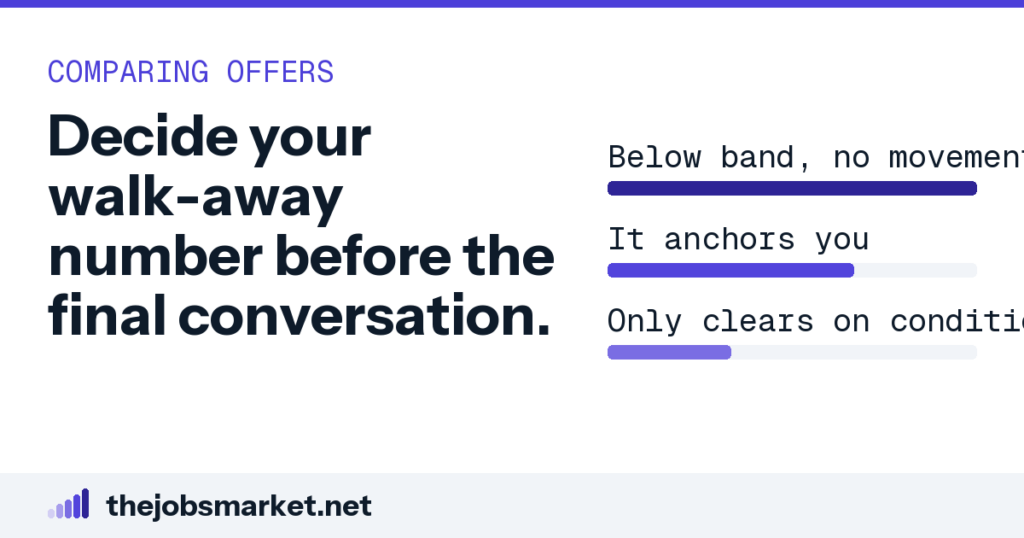
Walk away on pay alone when the offer sits below the published band for the occupation in your area and the employer will not move, when accepting would anchor you below market for years, or when the total only clears your current package through parts that are conditional. Interview fatigue is the main reason people accept offers they have already worked out are wrong.
The three cases where pay alone is enough
By the time a final offer arrives you have usually spent weeks on the process and the idea of starting again is exhausting. That exhaustion is the main reason people accept offers they have already worked out are wrong. There are three situations where pay by itself is a sufficient reason to decline, and each one is checkable rather than a matter of feel. Knowing which of them you are in makes the decision considerably easier.
The first is an offer below the published band with no movement on it. If the figure sits under the twenty-fifth percentile for your occupation in your metro and the employer has declined to move, you have a verifiable fact and a refusal. That combination is a complete argument on its own. Nothing further needs to be established.
The second is that it anchors you. Accepting substantially below market sets the base from which every subsequent raise, promotion and outside offer is calculated. The cost is not this year’s gap but that gap compounding for as long as you stay, and afterwards. The third is an offer that only clears your current package through its conditional parts, which means accepting a pay cut with an option attached.
Check the band before you decide anything
Below market is a feeling until the percentiles for your occupation in your metro are actually in front of you. The published spread runs from the tenth to the ninetieth percentile, and where an offer falls inside it is the difference between disappointing and genuinely bad. Those are different situations calling for different responses. Twenty minutes of lookup separates them.
An offer at the fortieth percentile is unexciting and entirely normal for somebody changing field or industry. An offer under the twenty-fifth, for somebody experienced in the same occupation and the same area, is a different object altogether. The first is a negotiation and the second may be a decline. Reading them as the same thing is how people either accept too readily or walk away from something reasonable.
We cannot move is two different sentences
Sometimes it means the band is set and the approval sits well above the person telling you. Sometimes it means they would prefer not to and have decided you will accept anyway. Those are entirely different situations and they sound identical over the phone. Distinguishing them is worth one more question.
Ask whether the constraint is the band for this level or the budget for this particular role. A band problem occasionally has a leveling answer, which is the same work at the grade above with a different band attached. A budget problem sometimes moves at the end of a quarter or when another requisition closes. Neither is worth guessing at when the question costs a single sentence.
The reason people accept anyway
Interview processes are long and demoralizing, and by the final stage the cost of continuing feels enormous while the cost of accepting feels abstract. That asymmetry is backwards. The search is a matter of weeks and the anchor is a matter of years, and the arithmetic runs strongly the other way. Fatigue is not a reason, it is a condition to plan around.
The practical defense is deciding your walk-away number before the final conversation and writing it down. It is much harder to talk yourself past a figure you committed to in a calmer moment. Write down the reasoning alongside the number, not just the number itself. A bare figure gets rationalized at nine in the evening; a figure with its justification attached is far harder to argue yourself out of.
What the gap actually costs over time
Take an offer $8,000 below what the role should pay, which is the kind of gap people talk themselves into accepting. If raises run three percent a year on both the accepted figure and the one you should have had, the gap does not stay at $8,000. It grows by three percent every year, and across five years it comes to about $42,500. That is the cost of one conversation you did not have.
Then it follows you out of the building. The next employer either asks what you currently earn or benchmarks its offer against comparable people, and your low base becomes the starting point for the negotiation after this one. That compounding is what makes pay a sufficient reason to decline where a long commute is not. A commute ends when the job does and an anchored salary does not.
How to decline without closing the door
Name the number that would have worked, thank them properly, and leave the door open. Employers reopen offers more often than candidates expect, because budgets shift, other candidates decline, and requirements change. A declined offer with a specific figure attached is easy for somebody to revisit later. A vague refusal gives them nothing to come back to.
Do not invent a competing offer to strengthen the position. It is among the most common pieces of advice on this subject and it is the worst, because it converts a straightforward negotiation into a bluff that can be called. Industries are smaller than people think and the person you told will remember. The upside is a few thousand dollars and the downside is the relationship.
If your current employer counters
A counteroffer that appears only because you were leaving tells you the money existed and was not being offered. That is worth weighing seriously rather than dismissing on principle. The question to ask is what changes structurally rather than what changes this month. A raise granted under notice frequently arrives instead of, rather than in addition to, the next cycle’s increase.
Ask for it in writing with the effective date and explicit confirmation that it does not replace the coming review. If that confirmation is refused, the counter was a retention tactic rather than a correction of your pay. The original problem has not moved and you now know it will not. That is useful information regardless of what you decide.
When pay alone is not the right reason
When the gap is small and something else about the role is clearly better, pay alone is the wrong basis for declining. A few percent sits inside the noise of any comparison you could build. Choosing a worse job over that margin is the mirror image of the mistake this whole article is about. Precision on one variable does not justify ignoring the others.
The same applies when a lower base buys something specific and time-limited. A career change, an industry you cannot enter any other way, or training that is genuinely rare are all reasonable things to pay for. That is a decision with a price on it rather than a mistake. Set a date by which the investment should have repaid itself, and check it when the date arrives.
The test
Here is the question that settles most of these. If you accepted this offer, and the market rate for your occupation were published on your desk every morning, would you be at peace with it in a year. If the answer is no, the offer will not improve after you sign it, because nothing about signing changes the band. The discomfort you are talking yourself out of now is the discomfort you will be living with.
Pay is one of very few things about a job that can be verified from outside before you start. The manager, the work, the politics and the actual hours are all discovered afterwards, and none of them is checkable in advance. Declining on the one variable you can confirm is not being difficult. It is using the only hard information available while you still have the leverage to act on it.
Common questions
When is pay alone a good enough reason to decline?
When the offer sits below the 25th percentile for your occupation and metro and the employer will not move, when it anchors you below market for years, or when it only clears your current package on conditional parts.
Why does accepting a low offer cost more than the gap?
Because the gap compounds. An $8,000 shortfall with three percent raises on both figures is roughly $42,000 over five years, and it becomes the base the next employer benchmarks against.
Why do people accept offers they know are wrong?
Interview fatigue. By the end the cost of continuing feels enormous and the cost of accepting feels abstract, but the search is weeks and the anchor is years.
How do I decline without burning the bridge?
Name the number that would have worked, thank them properly and leave it open. Offers get reopened more often than people expect, and a specific figure is easy to revisit.
When is a pay gap not a good reason?
When it is a few percent and something else is clearly better, or when the lower base buys a career change or rare training — provided you know the price and the date it should be repaid.
How do I know if an offer is really below market?
Look up the published percentiles for your occupation in your metro. An offer at the 40th percentile is unexciting and normal; one under the 25th for an experienced candidate is a different object.
What does it mean when they say they cannot move?
Either the band is set above the person telling you, or they would rather not. Ask whether the constraint is the band for the level or the budget for the role — the answers differ.
Should I take my current employer's counteroffer?
Weigh it, but get the effective date in writing and confirmation that it does not replace the coming review. A raise that arrives instead of the next one has not fixed anything.