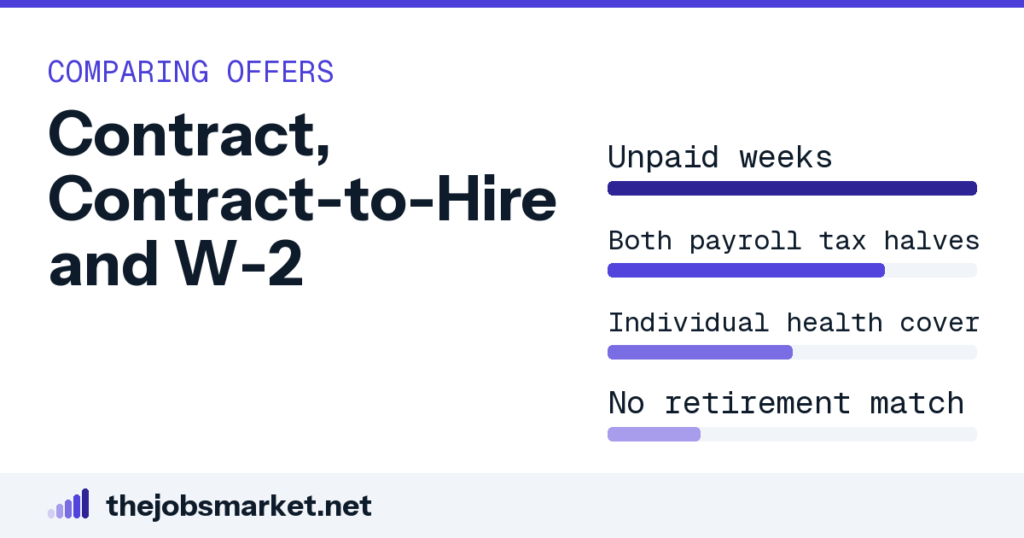
A contract rate has to cover everything an employer would otherwise provide: self-employment taxes, health coverage, retirement contributions, unpaid time off, and periods between engagements. Converting a salary to an equivalent contract rate typically means adding 30% to 50%, and a contract rate that looks generous against a salary frequently is not once those are accounted for.
The three arrangements
A recruiter offers $65 an hour against the $100,000 salary you have now, and it sounds like a substantial raise. Worked through properly it is a pay cut, and the arithmetic that shows it takes about ten minutes. A contract rate and a salary are different currencies, and converting between them badly is the most reliable way to accept less money while believing you gained. The conversion is not difficult; it is simply never done.
Start with what is actually on offer. W-2 employment means the employer withholds your tax, pays the employer half of payroll taxes, and usually provides benefits. You get notice, unemployment eligibility and paid leave alongside the salary. Independent contracting means you are your own employer: you pay both halves of payroll taxes, buy your own coverage, fund your own retirement, and are paid strictly for time worked.
Contract-to-hire is a third shape, with contract terms and a stated intention to convert to employment later. The intention is not a commitment and the conversion salary is frequently left unagreed at the outset. That omission is the thing to fix before you start rather than after. Once you are inside the job at the current rate, your position in that conversation is the weakest it will ever be.
W-2 through an agency is a fourth thing
A great deal of contract work is actually W-2 employment with a staffing agency rather than independent contracting, and both get described with the same word. On agency W-2 the agency withholds your tax and pays the employer half of payroll taxes, so your rate does not have to absorb those. Benefits are usually thin or absent, and the engagement still ends whenever the client decides it does. It sits between the other two rather than beside them.
Ask which arrangement is on offer before doing any arithmetic at all. The answer moves the equivalent rate by roughly the employer payroll tax share on its own, which is 7.65 percent before anything else is counted. The word contract in a job posting does not tell you which of the two you are being offered. It is the first question, not a detail to clear up later.
What a contract rate has to absorb
Four things, and they are larger together than most people expect. The employer’s half of payroll taxes becomes yours, at a fixed percentage of everything you earn. Health coverage bought individually rather than through a group plan is materially worse pricing for the same cover. Retirement contributions continue with no employer match behind them.
The fourth is time, and it is both the largest item and the one most often ignored. Every public holiday, every sick day and every gap between engagements is unpaid. Working forty-six weeks a year instead of fifty-two is a twelve percent reduction before anything else enters the calculation. Nobody quotes a rate with that adjustment already made.
Then come the smaller items that only appear once you are running the arrangement. Liability insurance where a client requires it, an accountant, quarterly estimated tax payments, and any equipment your employer used to buy for you. None of those is large on its own and collectively they are not nothing. Budget for them rather than discovering them in month three.
The conversion, roughly
The method is four steps and you can do it on paper. Take the salary, add the employer payroll taxes you will now be paying yourself, then add what coverage and retirement will cost you out of pocket. Finally divide by the number of weeks you genuinely expect to bill rather than by fifty-two. That last division is where most conversions go wrong.
The result usually lands thirty to fifty percent above the salary you started from, and higher for anyone with a family to cover. Use your own figures rather than a rule of thumb, because the coverage number in particular varies enormously by household. A single person in good health and a family of four are not solving the same problem. The rest of the arithmetic is stable enough to reuse.
A worked conversion
Start from a $100,000 salary. The employer half of payroll taxes on that is roughly $7,650, so the loaded cost to the employer is about $107,650. Add family coverage bought individually, which commonly runs $1,500 to $2,000 a month, and take $20,000 as the figure. Add the retirement contribution the employer was making at four percent, or $4,000.
That comes to about $131,650 of annual cost simply to stand still. Now divide by the hours you will actually bill. At forty-six weeks of forty hours you have 1,840 billable hours, which gives an equivalent rate of $71.55 an hour. Divide the same figure by a full fifty-two weeks and it looks like $63.29 instead.
The six weeks you will not bill are worth about nine dollars an hour, and they are invisible in every conversation that begins from an annual number. So the $65 an hour that opened this article is below the standing-still rate, not above it. It reads like a raise to almost everybody who hears it. That is the whole trap in one line.
What contracting buys
None of this is an argument against contracting, which offers genuine things a salary does not. Control over what work you take and when. The ability to raise your rate without waiting for a review cycle. Deductible business expenses, and in some fields simply a higher gross figure than any employer would pay. For people who bill consistently and manage the gaps well, it wins clearly.
The risk is equally real and it falls entirely on you. There is no notice period, no unemployment eligibility in most cases, and no paid recovery from illness or anything else. A quiet quarter is your problem alone. Both halves of that trade belong in the decision rather than only the half that appears on the rate card.
The classification is not yours to choose
Whether you are an employee or a contractor is decided by how the work is actually controlled, not by what the contract calls you. If the client sets your hours, supervises your method and supplies the tools, the arrangement looks like employment however it is labeled. Misclassification is the client’s exposure rather than a favor they are doing you. The label on the paperwork does not settle it.
That cuts both ways and is worth knowing. A contractor doing what is functionally a job may have a claim to the benefits and protections that go with one. The tests that decide the question are published by the federal and state agencies that enforce them, and state tests are frequently stricter than the federal one. A state labor agency will discuss a situation without any obligation to file anything.
Contract-to-hire, specifically
Agree the conversion salary and the conversion date in writing before you start, not once you are inside. Without both, the conversion becomes a negotiation you conduct from the weakest position you will ever occupy. You will be sitting in the job, having already demonstrated that you will do it at the current rate. Nothing about that helps you.
Ask two further questions while you still have leverage. What proportion of contract-to-hire placements at this client actually converted last year, and does the agency charge a conversion fee that the client has to pay. That fee is sometimes the precise reason a conversion quietly fails to happen. Both questions have factual answers and both are fair to ask before signing.
Which one is right
Contracting suits people with a pipeline, a cash buffer and coverage arranged through another route such as a spouse’s plan. Employment suits people who need the floor: steady income, paid recovery, and somebody else carrying the cost of the gap between engagements. Both are reasonable choices made by sensible people. Neither is the grown-up option.
One asymmetry belongs in the decision though. Only employment lets you discover you were wrong six weeks in without it costing you the rent. That is not an argument against contracting, and it is a reason to size the buffer before you start rather than after. Run the conversion first, then decide with the real number in front of you.
Common questions
How much higher should a contract rate be?
Typically thirty to fifty percent above the equivalent salary, and higher if you are covering a family. Work it out from your own coverage and retirement costs rather than a rule of thumb.
What does a contract rate have to cover?
Both halves of payroll taxes, health coverage at individual rates, retirement with no match, and every unpaid holiday, sick day and gap between engagements.
What is the most commonly ignored cost?
Unbilled time. Working 46 weeks rather than 52 is a twelve percent reduction before anything else is counted, and it never appears in a conversation that starts from an annual figure.
Is contract-to-hire a good deal?
Only with the conversion salary and date agreed in writing before you start. Without them you negotiate from inside the job, having already shown you will do it at the current rate.
What does contracting genuinely buy?
Control over what you take, the ability to raise rates without a review cycle, deductible expenses, and in some fields a higher gross. It suits people with a pipeline and a cash buffer.
Is all contract work independent contracting?
No. Much of it is W-2 employment through a staffing agency, where the agency withholds tax and pays the employer payroll taxes. Ask which is on offer before doing any arithmetic.
Can I choose to be a contractor?
Not really. Classification follows how the work is actually controlled — hours, method, tools — rather than what the contract calls you, and misclassification is the client's exposure.
Is $65 an hour better than $100,000 a year?
No. Loading a $100,000 salary with payroll taxes, individual coverage and retirement comes to roughly $131,000, which over 46 billable weeks is about $72 an hour.