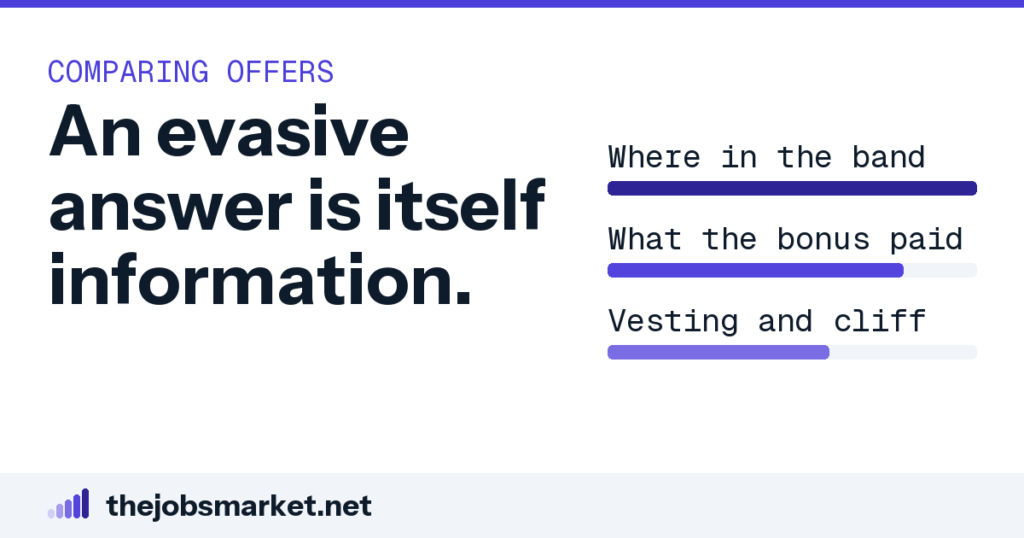
Before an offer can be compared to anything you need: the band for the level and where in it this sits, what the bonus actually paid last year, the vesting schedule and whether there is a cliff, the employer's contribution to insurance, the leave entitlement, the notice period, and whether pay is reviewed on a cycle. Employers expect these questions and an evasive answer to any of them is itself information.
The pay questions
An offer letter typically carries a base salary, a title and a start date, and that is not enough to compare it with anything. About eight pieces of information are missing, and every one of them is ordinary to ask for. Recruiters field these questions constantly and a candidate who asks good ones reads as serious rather than as difficult. The reluctance is almost always on the candidate’s side.
Start with pay. What is the base, and where does it sit inside the band for this level? What is the bonus structure, and what did people in this role actually receive last year rather than at target? Is any part of it guaranteed, and if so for how long?
Then ask when the next salary review falls and whether this offer is treated as already accounting for it. That second half matters more than it sounds. An offer made in November, two months before a review cycle, is a different proposition from the same offer made in February. Nobody volunteers which one you are looking at.
The benefits questions that carry real money
Ask what the employer contributes each month toward the premium for the coverage tier you would actually choose, and what your share would be. Ask what the out-of-pocket maximum is and when coverage begins, because a gap of thirty or sixty days is a real cost. For a family, the premium share alone can move a comparison by several thousand dollars a year. It appears on no offer letter anywhere.
Then the retirement contribution, and get the exact formula rather than the headline. Up to six percent and six percent are two different offers, and the difference is whether you have to contribute to receive it. Ask what the vesting schedule on the employer contribution is, since some plans claw it back if you leave inside a few years. Each of those questions has a factual answer somebody can look up in a benefits summary.
The equity questions, if equity is offered
Ask what type of instrument it is, how many units, and out of how many total shares. Ask for the vesting schedule and whether there is a cliff, since a twelve-month cliff means the first year is worth nothing if you leave inside it. Ask what the exercise window is after leaving, because roughly ninety days is common and it is the one deadline that cannot be recovered. Ask what happens on acquisition.
For a private company, two more questions decide most of the value. What was the most recent valuation and when was it set, and what liquidation preferences sit above common shares. A grant that looks substantial against a headline valuation can be worth very little behind a stack of preferences. Employers comfortable with their equity story answer all of this readily, which is itself the useful signal.
The questions about the work
Ask why the role is open: growth, a replacement, or somebody leaving. Ask what success looks like at six months, and who you would report to and how long they have been in post. A manager who arrived three weeks ago is a different job from one who has run the team for four years. None of that appears in a job description.
What happened to the last person in this role is the single most informative question on the entire list. It is also the one people are most reluctant to ask, which is why it stays informative. Ask it plainly and listen to the shape of the answer as much as the content. A promotion, a relocation and a quiet departure produce noticeably different responses.
The questions about how the place runs
Ask how pay is benchmarked: against this industry specifically, or against all employers in the metro. An employer that benchmarks against a low-paying sector will keep paying that way however well you perform, and knowing that now saves two years of hoping otherwise. Ask how many days people on this team actually took off last year, which is different from the entitlement. Ask whether on-call is paid and how often it comes round.
Every one of those has a factual answer, and every one is worth real money or real time across a year. They also tell you something the interview process is designed not to show you. A team that took nine days of a twenty-day entitlement is describing its own culture more accurately than any values page. Ask the question and let the number speak.
What to get in writing
Everything material belongs in the offer letter rather than in an inbox. That means remote or hybrid arrangements, any review commitment with its criteria, pay protection tied to a location, an agreed adjustment to the start date, and the bonus structure itself. Verbal understandings are made in good faith and they do not survive the departure of the person who made them. Managers move more often than most people expect.
Asking for a term in writing is completely normal and nobody competent is offended by it. Reluctance, on the other hand, is informative and worth attending to. An employer comfortable with a commitment documents it without discussion. One that resists is telling you what the commitment is actually worth, at no cost to you.
How to ask without seeming difficult
Send the questions in a single message rather than trickling them out over a week. Group them by topic, keep the tone straightforward, and frame the whole thing as wanting to evaluate the offer properly. That framing is true and it is also the one that lands best. A drip of individual queries feels like an interrogation in a way that one organized message does not.
If any question produces evasion rather than an answer, treat that as data. The answers you cannot get are frequently more informative than the ones you can, because they show you where the employer would rather not look. Note which question it was and weigh it. You are gathering information about the organization as much as about the package.
The two you should never skip
If you ask nothing else, ask what the employer contributes toward health premiums and what the bonus actually paid out last year. Those two move a comparison between offers more often than anything else on this page. Neither one appears on a standard offer letter, and neither is difficult for a recruiter to find out. Together they routinely change which of two offers is worth more.
Everything else here is worth asking and those two are worth insisting on before you decide anything. A comparison built without them is a comparison of the parts the employer chose to put in writing. That is a description of their letter-writing rather than of their pay.
When to ask them
Timing decides how the questions land. The pay and benefits questions belong after an offer exists and before you accept it, which is the short window where you have both information and leverage. Asking about premium shares in a first interview reads oddly and can cost you the process. Asking after you have signed is too late to change anything.
The questions about the work and the team belong earlier, during the interviews themselves. There they read as evaluation rather than as negotiation, and they signal that you are choosing rather than hoping. That signal is worth something on its own. Split the list in two along that line and each half arrives at the moment it works best.
What to do with an evasive answer
Ask once more, plainly and with a specific version of the question. Somebody may simply not have the figure to hand, and a second ask with a narrower scope frequently produces it. If the answer is still evasive after that, stop asking and start weighing. An employer who will not say what the bonus paid last year is telling you something about the bonus.
The same reasoning applies to hesitation about putting an agreed term in writing. That reluctance is about the term rather than about the paperwork, whatever reason is given. It is far cheaper to discover now, while you can still decline, than a year into the job when the person who promised it has moved on. Treat the hesitation as the answer.
Common questions
Is it safe to ask these questions?
Yes. Every one is a factual question about terms already offered. Nobody withdraws an offer because a candidate asked about the vesting schedule.
What is the single most useful question?
Where in the band this offer sits. It tells you whether there is room to move and therefore whether negotiating is worth the effort.
What does unlimited leave actually mean?
It is a policy rather than an entitlement. In practice it usually means no accrued balance and no payout when you leave, and often less leave taken rather than more.
Why does the review cycle matter?
Joining a month after one can mean eleven months before your first increase. It is worth knowing, and occasionally worth negotiating an off-cycle review at the outset.
Should I ask by email or on a call?
Email. The answers are detailed, you will want them when comparing, and the person answering can go and check rather than guess.
What should I ask before accepting an offer?
Base and band position, actual bonus payouts last year, employer premium contribution and out-of-pocket maximum, retirement formula and vesting, and when coverage begins.
Which question is most informative?
What happened to the last person in this role — and it is the one people are most reluctant to ask.
What must be in writing?
Remote arrangements, review commitments, location-based pay protection, start date adjustments and the bonus structure. Verbal assurances do not survive a manager leaving.