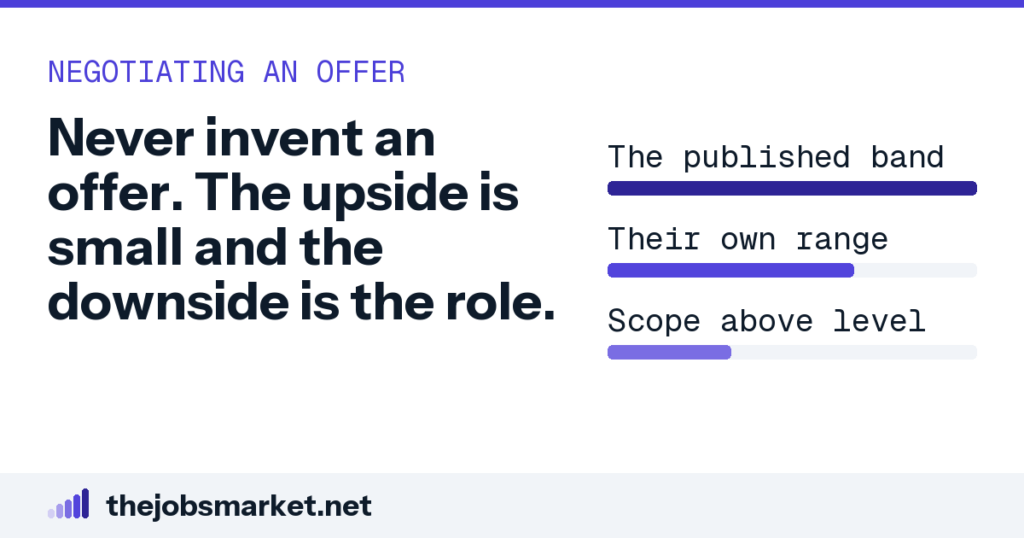
Without a competing offer you negotiate on evidence rather than leverage: the published band for your occupation and area, where the offer sits in the employer's own range, and scope you would be carrying beyond the level. Those work because they are checkable. Inventing a competing offer does not work, because employers occasionally call the bluff and the position is unrecoverable.
Most people negotiate without one
The advice everywhere is that a competing offer is what gives you leverage, which leaves most people concluding they have none. Competing offers are the exception rather than the norm, and the great majority of successful negotiations happen without one. The idea that you need leverage of that particular kind is largely folklore. Believing it is expensive, because it stops people asking at all.
What actually moves an offer is a specific request with a defensible basis, delivered to somebody who wants to hire you. That person has already spent weeks getting to this point and has told colleagues you are the one. None of that changes because nobody else has made you an offer. The conversation you are worried about having is one the employer has had many times and expects to have again.
The leverage you already have
They chose you, and that decision has a cost attached to reversing it. Restarting means reopening the process, re-interviewing, and explaining internally why the preferred candidate walked away. That cost is real, it is measured in weeks, and it exists whether or not anybody else is bidding. It is also the reason the offer stage is a conversation rather than a notification.
You also hold one piece of information they do not have, which is what you would actually accept. They are guessing at it, and the whole negotiation exists because of that gap. Every question they ask about your expectations is an attempt to close it. You are not the only party in the room without full information.
What replaces a competing offer
Three things do the work, and all three share the property a competing offer lacks. The first is published market data: the median and the full spread for your occupation in your metro. It is checkable by anybody, it does not depend on your word, and it does not expire during the conversation. That is the foundation and it should come first.
The second is what comparable roles are advertising locally right now, including this employer’s own postings in pay transparency states. That covers the objection that survey data is a year old. The third is specifics about the role itself: scope beyond what the posting described, or a requirement you meet that they said distinguishes the top of the range. That one is about the job rather than about the market, and it is the hardest to argue with.
Notice what those three have in common. Each one is verifiable, which is precisely what a competing offer is not. An employer cannot check your rival offer and can check every one of these. That makes them slower to deploy and much harder to dismiss.
Never invent one
A fabricated competing offer is occasionally effective and catastrophic when it fails. Employers sometimes respond by wishing you well and moving to the next candidate, and there is no way back from that. Industries are also smaller than people think, and the person you told will remember. The upside is a few thousand dollars and the downside is the role.
It also destroys the thing that makes the rest of your argument work. Your whole case rests on being someone whose statements can be checked and found correct. Once one claim turns out to be invented, the checkable ones stop being believed too. You cannot run an evidence-based argument and a bluff in the same conversation.
What you can honestly say about other processes
If you are genuinely in other conversations, saying so is fine and requires no specifics at all. Something like being in a couple of other processes and wanting to resolve this one is true, non-committal, and creates a reasonable timeline. It gives the recruiter a reason to move without giving them anything to verify. That is the honest version of the same pressure.
If you are not in other processes, say nothing about it. Silence is not a claim and nobody will ask you to confirm you have no alternatives. The market argument does not need company to work. Adding a vague hint of other interest to a well-sourced case weakens it rather than strengthening it.
The framing that works without leverage
Enthusiasm plus a specific ask is the whole formula. Say you want the job, name the published median and the seventy-fifth percentile for your metro, and ask whether you can get closer to the higher figure given the scope discussed. That is one short paragraph and it contains everything needed. Nothing about it is aggressive.
What it does is give the recruiter something to advocate with internally, which is what actually produces movement. Somebody has to argue for you in a meeting you are not in, using a sentence they can repeat accurately. Enthusiasm tells them you will accept if they win; the evidence tells them how to win. Leaving out either half makes their job harder.
When the answer is a firm no
Take the answer and move immediately to the terms that do not touch the band. Start date against a vesting event, a sign-on bonus, the employer retirement contribution, additional leave, or a defined six-month review with written criteria. Each of those is decided differently from base pay and often by a different person. A no on base is not a no on any of them.
These requests frequently succeed in exactly the conversations where base could not move. They cost the employer less, they require no exception to an approved band, and they do not affect anybody else’s pay. The review commitment in particular is worth pushing for, because it converts a refusal now into a date and a standard. That is far better than an assurance that things will be revisited at some point.
Why this matters more than the leverage question
Most people never ask at all, and the compounding cost of that decision dwarfs any single negotiation. Every future percentage increase, bonus and retirement contribution is calculated from the base you accepted. A gap that opens at hire widens every year rather than closing. That is the arithmetic actually at stake.
The realistic outcome of asking well without a competing offer runs from nothing to about ten percent, against a cost of one carefully written email. Nobody has their offer withdrawn for asking a reasonable question with evidence attached. That arithmetic does not need leverage to favor asking. It only needs you to prepare the three things above.
The mistake that substitutes for leverage
When people feel they have no leverage they tend to reach for a reason instead: rent, a move, a family expense, a number they need to hit. It feels like an argument because it is a real constraint on your side. It puts the conversation on ground where the employer has no obligation and no comparable to reason from. And it quietly asks them to pay you for your circumstances rather than for the work.
The market argument works because it is about the role, which is the one subject you both have a stake in getting right. Your circumstances are about you, and a recruiter cannot take them into a compensation meeting. Keep the two entirely separate even when your circumstances are what is really driving the request. The evidence travels and the need does not.
Common questions
Can I negotiate without a competing offer?
Yes, on evidence rather than leverage — the published band, where the offer sits in the employer's range, and scope beyond the level. All three are checkable.
Should I invent a competing offer?
No. Employers ask for details more often than people expect, and a fabrication that unravels can end the offer. The upside is a few percent and the downside is the role.
What can I say honestly about other processes?
That you have other conversations underway and would rather close this one. It is true, useful, and cannot unravel.
How do I get real leverage quickly?
Tell any genuinely live process that you have an offer with a date. Most accelerate, which converts an honest statement into a real competing offer within days.
How much can I expect to gain?
Modest without leverage — worth one considered email rather than a fight. A few percent at hire compounds for years, which is where the value is.
Can I negotiate without a competing offer?
Yes, and most successful negotiations happen without one. What moves an offer is a specific request with a defensible basis, not rival leverage.
What replaces a competing offer?
Published market data for your occupation and metro, advertised ranges locally, and specifics about scope beyond what the posting described.
Should I imply I have other offers?
Only if true. A fabricated offer is catastrophic when called, and it makes your checkable arguments stop being believed.