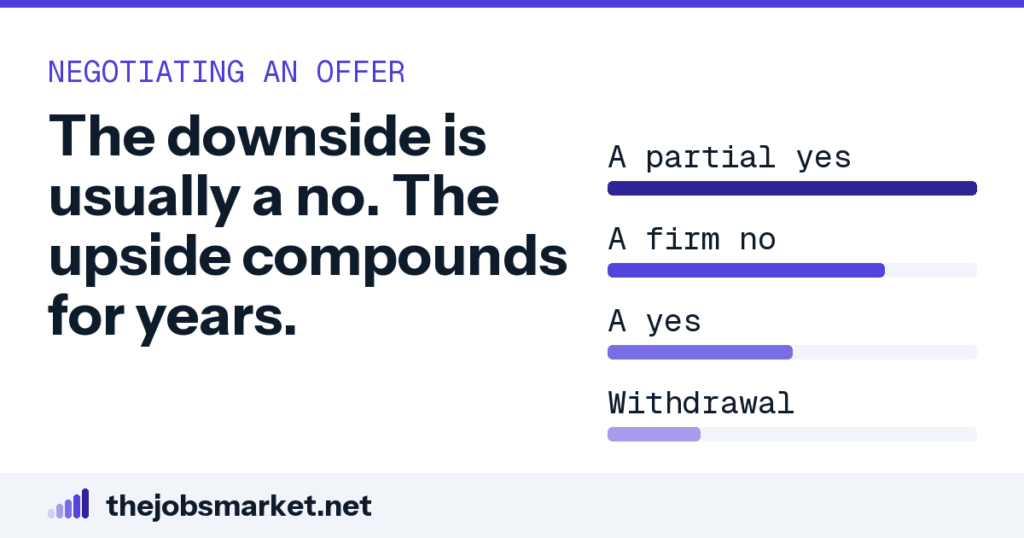
The overwhelmingly common outcome of asking for more is a partial yes — a smaller increase than requested, or movement on something other than base. A firm no is the next most likely and costs you nothing when the ask was reasonable. A full yes happens more often than people expect. Withdrawal is rare and is almost always about how somebody asked rather than that they asked at all.
What almost always happens
Somebody asks for more money, politely and once, and the employer responds. That is the whole event. The version people fear — an offended hiring manager pulling the offer and telling the recruiter never to call again — is rare enough that most recruiters can go years without seeing it.
The most common response by some distance is a partial yes. You ask for $95,000 against an offer of $88,000, and what comes back is $91,000, or $88,000 with a $5,000 signing bonus, or the base plus an agreed review at six months. Employers frequently have some room and rarely have all the room you asked for.
The second most common is a straightforward no, delivered without any change to the relationship. The offer stands, everybody moves on, and you have lost nothing except the two minutes it took to ask. A no is not a punishment; it is an answer to a question you were entitled to ask.
A full yes happens more often than candidates expect, particularly where the original number was set conservatively to leave negotiating room. Some employers build that room in deliberately, which means the first number was never expected to be the final one. Sales-heavy and startup employers do this most consistently. Ask and you find out which kind you are dealing with.
Why the fear is out of proportion
The fear makes sense psychologically and does not survive contact with how hiring actually works. By the time an offer is extended, an employer has spent weeks on the process — screening, interviewing, coordinating panels, running approvals, declining other candidates. That investment is substantial and it is already sunk.
Restarting means going back to a shortlist that has moved on, reopening a requisition, and explaining to a hiring manager why the role is still empty. Against that, a few thousand dollars is a small number, and the person deciding knows it better than you do. Their alternative to agreeing is a considerably more expensive one.
There is also a reputational asymmetry that runs in your favor. A candidate who negotiates once, reasonably, reads as somebody who takes their own work seriously. Employers who have run many hiring processes expect it, and its absence is more often noticed than its presence.
The three responses you will get
Learning to recognize which response you have received tells you what to do next, and the three are easy to tell apart. Each one points at a different next move on your part.
A partial yes means there was room and you have found most of it. The correct move is to accept warmly rather than pushing for the remainder, because a second ask after a concession converts a good negotiation into a difficult one. Take the improvement, say thank you, and close the conversation there.
A firm no with a stated reason — a band ceiling, an approved level, internal equity with people already in the role — is usually genuine. Those constraints are real, the person telling you cannot change them, and pushing against them produces frustration rather than money. The useful follow-up is to ask what else is movable.
A no without any reason is a different signal. It may mean the person has no authority and has not asked anybody, in which case a single gentle “is there any flexibility, or is this fixed?” sometimes produces movement that the first ask did not produce. Ask that question once and then stop pushing entirely.
Ask once, specifically, in writing
The mechanics of how you ask matter more than the exact wording. Ask once rather than repeatedly, name a specific figure rather than gesturing at “more”, and put it in writing where you can so that whoever has to seek approval can forward your actual words rather than their summary of them. Approvals tend to move faster on the original wording than on a paraphrase. A forwarded message also fixes what you actually said.
Attach a reason that is about the role and the market rather than about your needs. “Based on published ranges for this role in this market I was targeting $95,000” gives somebody an argument they can take to a manager. “I need $95,000 to cover my costs” does not, because your costs are not something the employer can put in an approval request.
And say clearly that you want the job. The single most common mistake is asking in a way that sounds like hesitation, which makes an employer wonder whether the increase would even secure you. “I’m excited about this and would accept today at $95,000” removes that doubt entirely.
What actually damages a negotiation
Very few things do, and it is worth knowing which. Asking repeatedly after receiving an answer is the main one, because each additional ask spends goodwill that the first ask cost you nothing to spend. The currency runs out quickly.
Inventing a competing offer is the other. Recruiters in a single market talk to one another far more than candidates assume, and a fabricated offer that surfaces is the one version of this that ends processes. A real competing offer is powerful and an imaginary one is a serious risk.
Renegotiating something already agreed, or adding new demands after each concession, turns a negotiation into a pattern that employers recognize and dislike. Ask for everything you want at once, in a single message, and then respond only to what comes back. Sequential demands read very badly to anybody who hires regularly. One message is the whole negotiation.
The version that reliably works
One short message covering three things: enthusiasm, a specific number, and a reason grounded in the market. “Thank you — I’m really pleased and would like to accept. Based on published ranges for this role in this area I was targeting $95,000; is there flexibility to get closer to that?”
That is a complete negotiation. It is polite, it is specific, it gives the recruiter something to forward, and it makes clear that a yes closes the process. Nothing more elaborate performs better, and elaborate versions frequently perform worse.
When base genuinely cannot move
Sometimes the constraint is real, and in those cases the money may be elsewhere. Signing bonuses come from a different budget in many organizations and are often available when base is fixed, because they do not affect the salary band or internal equity between people already in the role. That is precisely why they are easier to approve.
Start date, additional leave, a review at six months with a stated figure attached, equity, a professional development budget, or a title that affects your next move are all negotiable in situations where base is not. Asking what else is movable is a productive question that costs nothing at all after a no has already been given. It also signals that you are still interested rather than deflated.
The six-month review is the most underrated of these. An agreed review with a number attached and a date in writing converts a fixed offer into a deferred increase, and it is much easier for a manager to approve than an exception to a band that has already been approved. Managers approve future promises more readily than present ones.
The realistic expectation
Expect a partial yes, prepare to accept it gracefully, and treat anything more as a good outcome. Across a career the arithmetic is decisive: a $4,000 increase secured in one two-minute conversation compounds through every future percentage raise and every future offer benchmarked against it. Very few two-minute conversations pay that well.
The downside, realistically, is a no. The upside runs for years. That asymmetry is the entire argument for asking, and it does not require you to be a skilled negotiator — only to ask once, clearly, and mean it.
Common questions
What usually happens when I ask for more?
A partial yes is by far the most common — a smaller increase than requested, or movement on something other than base. A firm no is next, and costs nothing when the ask was reasonable.
Will the offer be withdrawn?
Rarely, and almost always because of how somebody asked rather than that they asked. By offer stage the employer has weeks of sunk investment, and restarting costs far more than a few thousand dollars.
How should I ask?
Once, with a specific figure, in writing, with a reason about the role and market rather than your personal costs — and say clearly that you want the job.
Why does the reason matter?
Because whoever seeks approval needs an argument they can forward. A published market range is one; your household costs are not something an employer can put in an approval request.
What if I get a partial yes?
Accept warmly rather than pushing for the rest. A second ask after a concession converts a good negotiation into a difficult one.
What actually damages a negotiation?
Asking repeatedly after an answer, inventing a competing offer, and adding new demands after each concession. Recruiters in one market talk to each other constantly.
What if base genuinely cannot move?
Ask what else is. Signing bonuses often come from a different budget, and start date, leave, equity, title and a dated six-month review are all negotiable when base is fixed.
Is it worth the discomfort?
The downside is usually a no. A $4,000 increase compounds through every future percentage raise and every offer benchmarked against it, for years.