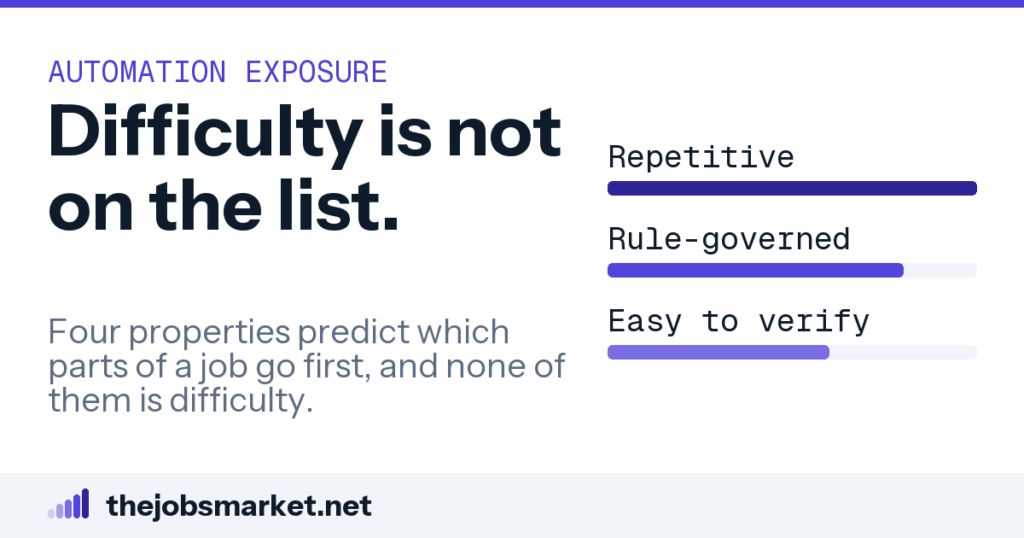
The tasks automated earliest are repetitive, rule-governed, high-volume and easy to verify. Difficulty is not the criterion — chess is hard and was automated decades ago, while folding laundry reliably is easy for a person and remains hard for a machine. Judged by these four properties, most jobs contain some tasks that are highly exposed and others that are not exposed at all.
Four properties, and difficulty is not one of them
Four properties predict which parts of a job go first, and none of them is difficulty. Getting that straight is most of what makes this subject tractable. Difficulty is the axis everybody reaches for and it misleads.
The first is repetitive, meaning the same operation performed many times over. That supplies both the economic case for building the system and the training data to build it with. Repetition supplies both the reason and the raw material.
The second is rule-governed: a right answer that follows from the inputs rather than a judgment reasonable people could disagree about. Following a detailed procedure qualifies, while deciding when the procedure does not apply does not. Judgment about exceptions is the opposite of rule-governed.
The two properties people leave out
High volume is the third, meaning enough throughput to justify building or buying the system. That is why an identical task gets automated at a large employer and done by hand at a small one. Scale decides whether the system is worth building at all.
Easy to verify is the fourth and the most overlooked. Somebody has to be able to tell quickly whether the output is right. Detectability of error is the property that governs trust.
Where errors are expensive and hard to spot, adoption slows sharply regardless of technical capability. That single property explains more variation in adoption speed than the technology does. Two sectors with identical tools adopt at different rates.
Why difficulty is the wrong axis entirely
The tasks people find hardest are frequently the ones machines handle best. Complex reasoning, technical analysis and producing polished writing all fall into that category. Cognitive difficulty turns out to be no protection whatsoever.
The tasks people find trivial are where machines still struggle badly. Moving through a cluttered room, reading a situation, and knowing when a rule should not apply are all effortless for a person and genuinely difficult to build. Physical common sense remains the hardest thing to replicate.
Anybody assessing their own exposure by asking how skilled their work is will get the answer backwards. Chess was automated decades ago and folding laundry reliably is still hard. That pair is the clearest illustration of the whole point.
Verification is the property nobody talks about
It explains most of the variation in adoption speed across industries with identical technology available to them. Two sectors can have the same tools and adopt at completely different rates. The variation comes from consequences rather than capability.
Software gets automated fast because output is testable and a wrong answer surfaces immediately. Medicine and law lag badly because a plausible wrong answer is dangerous and expensive to detect. Plausible errors are worse than obvious ones in those fields.
The capability may be identical in both cases. The consequence of an undetected error is not, and that is what actually governs the pace of adoption. Consequence rather than raw capability sets the actual timetable.
Volume explains the inconsistency you observe
People are frequently puzzled that a task is automated at one employer and manual at another in the same industry. It looks like one of them must be behind. Neither is behind and the economics simply differ.
That is almost always volume rather than sophistication. The system has to be worth building, and below a certain throughput it simply is not. The threshold is a business calculation rather than a technical one.
Which means the same job is exposed differently depending on the size of the organization you do it in. No exposure index captures that, because indices attach to occupations rather than to employers. Employer size is invisible to every published index.
Running the four properties over your own week
List what you actually do, with rough time shares attached, then score each task against the four properties. The exercise takes about twenty minutes and produces something no published index can. Your own time shares are the input nobody else has.
You will usually find a clear split rather than a single verdict. That split is exactly why occupation-level scores mislead individuals. An average across a bundle describes nobody in particular.
Anything scoring exposed on all four will get faster soon regardless of your industry. Anything scoring low on verification is protected for considerably longer than its raw capability suggests. Verification difficulty buys years of protection rather than months.
The tasks that resist, and why
Four kinds of work resist consistently. Physical work in unstructured settings, work whose value is partly that a person did it, work where somebody must be accountable to a regulator or a court, and work that involves deciding what should be done rather than doing it. Deciding what to do is a different activity from executing it.
Notice that only the first is about technical capability at all. The other three are about institutions, trust and responsibility. Those three are social arrangements rather than technical problems.
Those move on a much slower clock than technology does and will not be resolved by a better model. That is why they are the durable end of the spectrum rather than merely the current one. Durability here rests on something other than difficulty.
Why the order matters more than the total
Knowing that some share of your work is exposed is much less useful than knowing which parts go first. A percentage tells you to worry and an order tells you what to do. Order is the difference between anxiety and a plan.
The four properties give you that order, and an order is actionable in a way a percentage never is. It tells you which skills to stop investing in and which to build. Investment decisions need a sequence rather than a total.
The parts that go first are the parts you should be least invested in demonstrating. If your reputation rests on being fast and accurate at something repetitive, rule-governed, high-volume and easy to check, that reputation has a shelf life regardless of how good you are. Excellence at an automatable task is still automatable.
The uncomfortable version
The four properties also describe what makes work easy to measure. That overlap is not a coincidence and it has an unpleasant consequence. Measurability and automatability share the same underlying properties.
What is easy to measure is what performance reviews reward. So the tasks most likely to be automated are frequently the ones you are most credited for. Reward and exposure end up pointing at the same tasks.
People who are excellent at the measurable part and indifferent at the rest are the most exposed, and they are usually the last to notice. Every signal they receive at work says they are doing well. Positive feedback is exactly what conceals the exposure.
Common questions
Which tasks are automated first?
Repetitive, rule-governed, high-volume tasks whose output is easy to verify. Difficulty is not one of the criteria.
Why is difficulty the wrong measure?
Because complex reasoning and polished text are handled well by machines, while moving through a cluttered room is not.
Why does verification matter so much?
Where a plausible wrong answer is dangerous and hard to spot, adoption slows regardless of capability — which is why medicine and law lag software.
Does volume really matter?
Yes. The same task gets automated at a large employer and done by hand at a small one, because the system has to be worth building.
Which tasks resist automation?
Physical work in unstructured settings, work valued because a person did it, work requiring accountability, and deciding what should be done.
Which tasks get automated first?
Repetitive, rule-governed, high-volume tasks whose output is easy to verify. Difficulty is not one of the criteria.
Why does verification matter so much?
Where a plausible wrong answer is dangerous and hard to detect, adoption slows regardless of capability — which is why medicine and law lag software.
Why is the same task automated at one employer and not another?
Volume. The system has to be worth building, so below a certain throughput it stays manual — a variable no occupation-level index captures.