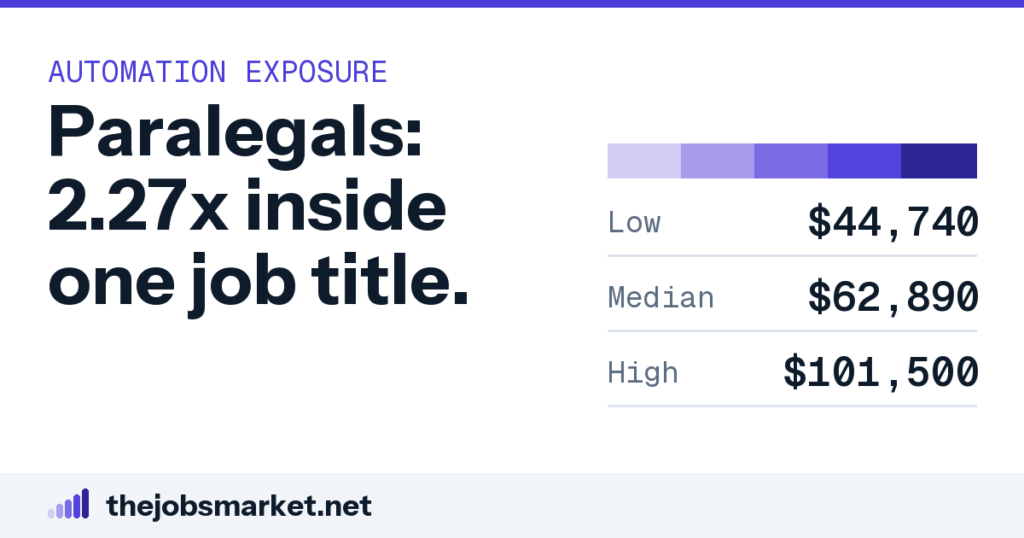
Automation removes the parts of a job that are most similar between people, leaving the parts that differ most. That widens the pay distribution inside a single occupation. Paralegals — an occupation whose document review was heavily automated — run from about $44,740 at the tenth percentile to $101,500 at the ninetieth, a spread of more than two and a quarter times inside one job title.
The mechanism, in one sentence
When the routine part of a job goes, the gap between the best-paid and worst-paid people doing it tends to widen. That happens without the job title changing at all. Nothing in the employment data registers the change.
Automation removes the tasks where people perform most alike, leaving the tasks where they differ most. Routine work is where two competent people produce nearly identical output. Similarity of output is what makes work routine.
Judgment, relationships and specialized knowledge are where they do not. Take away the first and what remains is precisely the part that separates people from one another. The distinguishing half is all that survives the process.
What that looks like in a real occupation
Paralegals are the clearest case available, because their document review was heavily automated and the occupation itself held steady. The distribution tells the story the headcount hides. Stable employment concealed a considerable change inside the occupation.
They run from about $44,740 at the tenth percentile to $101,500 at the ninetieth, with a median of $62,890. That is a spread of more than two and a quarter times inside one occupation, one country and one job title. Geography and employer explain only part of that range.
Somebody at the tenth percentile and somebody at the ninetieth are described identically by every employment statistic. They are having completely different careers. One statistic covers two genuinely different working lives.
Why the median stops being useful here
An occupation with a widening spread can hold a perfectly stable median while the experiences inside it diverge sharply. The midpoint is the last number to move. Medians are stable precisely because they average the ends.
Reading the median tells you the occupation is fine and tells you nothing about which half you are in. Those are different questions and only one of them is about you. Occupational health tells you nothing about your position.
This is the strongest argument available for reading a whole distribution rather than a midpoint. It matters most in exactly the occupations where people most want reassurance. Reassurance and information point in opposite directions here.
What separates the ends
It is usually not tenure, which is the assumption most people default to. Years in the role explain considerably less than people expect. Time served has weakened as a predictor in these occupations.
In occupations reshaped by automation, the top tends to be defined by handling the non-standard case, taking responsibility for the output, and dealing directly with whoever the work is for. Those three keep appearing across every occupation this happens to. The consistency across fields is what makes it a pattern.
They are also the parts a tool does not do for you, and the parts hardest to demonstrate on a resume. That difficulty is part of why the gap persists rather than closing as people move between employers. Advantages that are hard to signal persist across job changes.
The same tool, opposite effects
A tool that makes the routine part of your job faster has two possible effects and they point in opposite directions. Which one you get depends on where the rest of your value sits. The tool is neutral and your task mix is not.
It helps you most if your value is elsewhere, because it clears time for the part that actually distinguishes you. It helps your employer most if your value is not elsewhere. Same software and same title, with opposite consequences entirely.
That is one technology producing opposite outcomes for two people with the same job title. It is also why occupation-level advice about automation is so weak: the useful question is never what happens to your occupation, but which end of it you are moving toward. Direction within the distribution is the actionable question.
Reading your own occupation’s spread
Pull the published percentiles rather than the median, which takes one lookup in the same table. The tenth and ninetieth are the two that matter. Those two numbers frame everything the median conceals.
A wide gap between them means the occupation rewards something specific, and the question becomes whether you are doing that something. That is answerable by looking at how you spend your week. Your own task list answers it without any further research.
A narrow spread means the opposite: the work is standardized, people are close substitutes, and progression comes from changing occupation rather than climbing within it. Both facts are useful and neither is visible in a median. Both shapes call for completely different career plans.
Where the spread comes from in the first place
Not every wide distribution is caused by automation, and assuming so would be a mistake. Three other explanations are common. Wide distributions have several genuinely unrelated causes behind them.
An occupation can be spread because it covers several different jobs under one code, because employer type varies enormously, or because it is practiced in both expensive and cheap metros. All three produce wide ranges for reasons that have nothing to do with technology. Occupational coding alone can produce an enormous range.
What distinguishes the automation version is that the spread widens over time while the occupation’s tasks visibly change. If the bottom of your occupation is doing what everybody did ten years ago and the top is doing something else, that is the pattern. Task divergence over time is the distinguishing signature.
What to do if you are in the lower half
The move is toward the tasks that define the top of your occupation. Identifying them is easier than it sounds. The information is available from anybody willing to answer.
Ask what the highest-paid people in your occupation actually spend their time on. It is rarely a different skill; it is a different task mix and considerably more exposure to the people who decide things. Proximity to decisions explains more than technical skill does.
The uncomfortable part is that those tasks carry risk and visibility, which is precisely why they are available to be claimed. Nobody is competing for the escalation that nobody wants to own. Unclaimed responsibility is the cheapest route upward available.
The uncomfortable arithmetic of staying put
In a widening occupation, standing still means falling relative to the top even when your own pay rises every year. Both things happen at once and only one of them is visible to you. Your payslip rises while your relative position falls.
The distribution stretches around you, so the same percentile buys a progressively smaller share of what the occupation now pays. Your raise was real and your position moved anyway. Both facts are true and only one of them is measured.
That is invisible year to year and stark across a decade. It is the reason people in reshaped occupations describe working just as hard for progressively less standing, without being able to point at anything that went wrong. Nothing went wrong and the distribution moved regardless.
Common questions
Why does automation widen the pay spread?
It removes the tasks where people perform most alike, leaving judgment and relationships — the parts where they differ most.
How wide can a spread be inside one job title?
Paralegals run from about $44,740 at the tenth percentile to $101,500 at the ninetieth, more than two and a quarter times.
Why is the median misleading here?
An occupation can hold a stable median while the experiences inside it diverge. The median cannot tell you which half you are in.
What separates the top of such an occupation?
Handling the non-standard case, owning the output, and dealing directly with whoever the work is for — not usually tenure.
Does a tool help me or my employer?
Both, in different proportions depending on whether your value sits in the routine part or beyond it. Same technology, opposite outcomes.
Why does automation widen the pay spread?
It removes the tasks where people perform most alike, leaving judgment and relationships — the parts where they differ most.
How wide can the spread be inside one job title?
Paralegals run from about $44,740 at the tenth percentile to $101,500 at the ninetieth — more than two and a quarter times.
Why is the median misleading in these occupations?
An occupation can hold a stable median while experiences inside it diverge sharply. The median cannot tell you which half you are in.