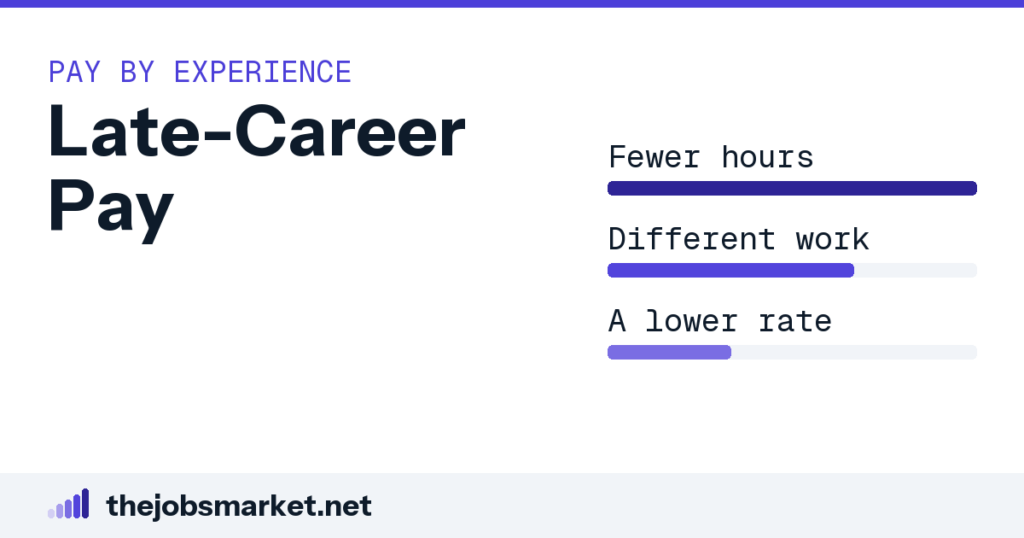
Published wage data cannot show a late-career decline because it measures what jobs pay rather than what individuals earn over time. What survey evidence on earnings by age does show is that falling annual earnings are driven substantially by reduced hours and by voluntary moves into different work, rather than by employers cutting rates. The plateau that is real is structural: percentage raises on a high base stop feeling like progression long before anything actually declines.
What the data can actually show
Start with the limitation, because it governs how to read everything else. The main occupational wage survey is an establishment survey with no age breakdown at all — it reports what jobs pay, not what individuals earn as they get older. So it cannot show a career trajectory, and any article presenting one from it has built it from something else.
Household survey data does carry age, and it reports annual or weekly earnings for people in each age group. That is genuinely useful and it measures something different from what most readers assume: it captures total earnings, which move with hours worked as well as with rates of pay. The series does not separate those two things anywhere.
That distinction turns out to explain most of the phenomenon. A dataset showing lower median earnings among older workers is consistent with lower hourly rates, with fewer hours, with a shift into different work, or with any combination — and the data alone cannot tell you which. That ambiguity is the whole reason this subject stays muddled.
The three things people mean by plateau
The word covers three quite different situations, and conflating them is why the subject produces so much contradictory writing. Three different claims share one word. Separating them is most of the work here.
The first is a genuine slowdown in raises, where increases fall from meaningful to cost-of-living-sized. This is real and it is nearly universal, and it happens because you have reached the top of a band rather than because anybody reassessed your value. Nothing about you changed at the moment the raises slowed.
The second is a reduction in hours, which shows up in annual earnings and not in pay at all. Somebody moving from fifty-hour weeks to forty, dropping overtime, or shifting to four days has taken a pay cut in annual terms and no cut in rate. That is a choice, and it is frequently a good one.
The third is a move into different work — consulting, part-time, a less demanding role, a portfolio of things. Earnings change, sometimes downward, and the comparison to a previous full-time salary is measuring two different lives rather than one. The comparison is not measuring what it appears to measure.
Why the plateau is structural
The genuine slowdown has a mechanical explanation that has nothing to do with age. Every role sits in a band with a top, and progression within a band is fast at the bottom and slow near the ceiling. Somebody twenty years into a role is usually near the top of theirs, so the same three percent that felt like progress at the bottom now barely moves anything.
The other structural piece is that the step changes in pay come from changing level rather than from performing well at one. Most large increases in a career are promotions, moves or specialization changes, and those become less frequent as people find a level that suits them. Staying somewhere comfortable is a choice with a price attached.
Put together, a plateau is usually a description of having arrived somewhere rather than of having declined. That reframing matters because the remedy for a ceiling is a level change, while the remedy people usually attempt is a better performance case, which cannot work against a band ceiling however good the case is. The constraint is the band, not the argument.
Where real decline does happen
It would be dishonest to say rates never fall, because in some situations they do. Physically demanding occupations sometimes force a move to lighter work at a lower rate, and that is a genuine decline rather than a reclassification. The work itself changed and so did the rate.
Involuntary job loss late in a career can also produce a real cut, because re-entry at a comparable level takes longer and the pressure to accept less rises with the length of the search. Age discrimination in hiring is a documented phenomenon, and its practical effect frequently shows up as a lower re-entry salary rather than as no job at all. That makes it considerably harder to see in aggregate data.
And industries in structural decline can cut rates for everybody in them, which affects older workers disproportionately because they are more likely to have spent a long time in one industry. Concentration of experience becomes a liability when the industry contracts. Breadth is worth more late than it was early.
The part that is not a plateau at all
One thing genuinely improves late in a career and gets discussed far less than it should. Total compensation frequently continues rising even where base salary flattens, because retirement contributions, accumulated leave, seniority-based benefits and equity that has had time to vest all keep accruing regardless of the base. None of that appears on the salary line.
Somebody whose base has not moved in three years may still be receiving materially more than they were, and looking only at the salary line misses it. That is worth calculating before concluding that nothing about your compensation is moving. The salary line is the least complete view available.
There is also the compounding effect running in your favor for once. A three percent raise on a high base is a larger sum than a six percent raise was on a low one, so the absolute increases may be growing while the percentages shrink. Both things can be true at once.
The three checks worth running
First, separate your hourly rate from the hours you actually worked. Work out your actual hourly figure this year and five years ago rather than comparing annual totals, because those two numbers answer two completely different questions. Only one of them is about what your employer thinks of you.
Second, find out where you sit in your band. The distance between your salary and the top of it is the entire space available to any raise conversation, and if that headroom is small the constraint is structural rather than about your performance. No amount of evidence beats a ceiling.
Third, check your total compensation rather than your salary. Add employer retirement contributions, the value of health coverage, accrued leave and any equity, and compare that total across years. It frequently tells a different story from the base salary line.
What actually restarts it
The things that break a plateau are the same things that produced the earlier increases, and none of them is performing better in the same role. A level change, a move to a different employer, a shift into a specialization with scarcity behind it, or a move into management where the genuine step changes in pay have always lived. None of that changes with age.
Changing employer is the most reliable of these and remains so late in a career, because an external hire is priced against the current market while an internal one is priced against their own history. That pricing gap does not close with age. If anything it widens, because internal histories get longer.
Specialization is the lever that people consistently underuse late on. Deep expertise in something few people have is worth more later in a career than earlier, because it takes years to accumulate and cannot be hired quickly. That is an advantage that grows rather than fades.
The advantage that grows rather than fades
Judgment, institutional knowledge and a network are all things that accumulate, and all three are hard for an employer to replace quickly. Somebody who knows why a system was built the way it was, or who can call three people to solve a problem in an afternoon, holds something that does not appear anywhere on a published pay band. It still has to be argued for explicitly.
The mistake is assuming it converts to money automatically. It does not, and the conversion usually requires the same explicit case-making as any other raise — naming the scope, the risk you absorb, and what would actually be lost if you left tomorrow. Nobody makes that case on your behalf.
Run that case against the band you are in and the market rate outside it. If the band cannot accommodate it, the answer is the same one it has always been, and it is a level change rather than a better argument. That has been the answer at every stage of a career.
Common questions
Does pay actually decline late in a career?
Rates usually do not. Falling annual earnings are driven substantially by reduced hours and by moves into different work, which are choices rather than cuts.
Why can published data not settle this?
The main occupational wage survey has no age breakdown and measures what jobs pay, not what individuals earn over time. Household data carries age but reports total earnings, which move with hours as well as rates.
What causes the genuine plateau?
Band ceilings. Progression within a band is fast at the bottom and slow near the top, so the same three percent that felt like progress early now barely moves anything.
Where does real decline happen?
Physically demanding work forcing a move to lighter roles, involuntary job loss late in a career where re-entry takes longer, and industries in structural decline.
What improves rather than flattens?
Total compensation often keeps rising while base flattens — retirement contributions, accumulated leave, seniority benefits and vested equity all keep accruing.
What three checks should I run?
Separate rate from hours by computing an hourly figure across years; find where you sit in your band; and compare total compensation rather than base salary.
What restarts pay growth?
A level change, a move to a different employer, or a specialization with scarcity behind it. Performing better in the same role cannot beat a band ceiling.
Why does changing employer still work late?
Because an external hire is priced against the current market while an internal one is priced against their own history. That gap does not close with age.