Total compensation is base pay plus the employer's share of health premiums, retirement contributions, paid time off, bonus and equity. The first four are factual and can each be established with one question. Bonus and equity are estimates, and the honest method is to count guaranteed money at face value, formula money at target, and discretionary money at zero.
The lines that make up a package
Base pay is the part everyone quotes and it is rarely more than three quarters of what a job actually pays. The rest is usually knowable to the dollar, and almost nobody asks for it. That gap between what gets discussed and what gets paid is where most bad offer comparisons come from.
A package has six components. Base salary is the only genuinely fixed part, and everything else references it: bonus percentages, retirement contributions and future increases are all calculated from the base. Variable cash covers bonus, commission, shift differentials and overtime. Equity comes next where it exists at all.
Then three that people leave out. Employer retirement contributions are cash you cannot touch yet but are unambiguously yours. Insurance matters through one number, which is the employer’s share of the premium. And paid time off has a computable value at your daily rate. Those last three are frequently worth more together than the entire bonus.
What published wage data actually covers
The national wage survey reports straight-time gross pay including commission and production bonuses. It excludes annual bonuses, equity, employer retirement contributions and insurance entirely. That is a deliberate design choice rather than an oversight, and it means the survey answers a narrower question than people assume.
So a published median is a wage figure rather than a package figure. Comparing it against a total compensation number quoted by a company is comparing two different measurements. The gap between them is not evidence that anybody is overpaid or that the data is wrong. It is the benefits, and they were never in the survey.
How to value each line honestly
Guaranteed cash goes in at face value, meaning the base and any bonus contractually guaranteed for a defined period. Formula-driven variable pay goes in at what the median person in the role actually achieved last year, not at target. Ask for that figure specifically, because the two differ more often than not.
Discretionary anything goes in at zero. That is not a prediction that it will never be paid, and it may well arrive every year. It means you cannot rely on it in a comparison, and valuing it at target is precisely how people accept packages that then underdeliver. Apply the same three rules to both offers and the comparison stays honest.
The employer contributions worth counting
A retirement match is deferred cash with a known percentage attached. An employer paying six percent against your own contribution is adding six percent to your compensation, and declining it by under-contributing is declining part of your salary. It belongs in the total at full value with no discount.
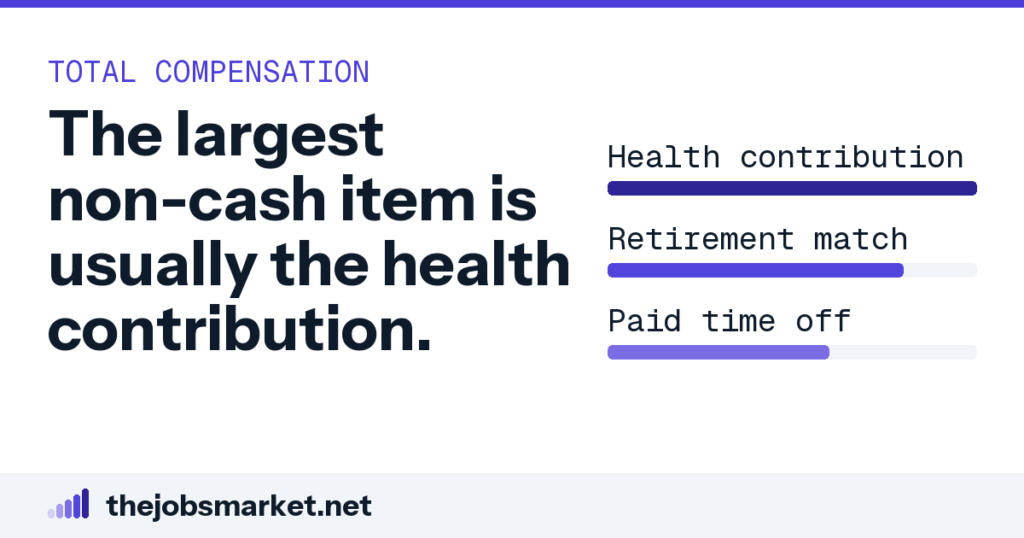
The health premium share is the other large one and is usually the single biggest non-cash item in any package. The number that matters is what the employer pays each month for the coverage tier you would actually choose, not the plan’s headline value. That is a fair question at offer stage and it has a precise answer. For a family it routinely runs into five figures annually.
Equity needs its own treatment
Public company shares vesting on a schedule are close to deferred cash carrying price risk. Value them at the current market price, discounted for the wait and for the concentration risk of holding one company’s stock while working there. That produces a defensible number you can put in a column.
Private company equity is a different instrument altogether. It has no market, its stated value comes from a funding round that may not repeat, and it may never convert into spendable money. Valuing it at the number printed in the offer letter is the most common overvaluation in this entire subject. Note it separately as a bet rather than adding it to a total.
The lines that reduce the total
Commuting cost and time come off the top of any package. So does required equipment the employer does not provide, unpaid on-call, and any certification or continuing education you fund yourself. Each one is a real expense created by the job and transferred to you.
These almost never appear in a comparison, and they are the reason two offers with identical totals can feel completely different a year into the job. Subtract them explicitly rather than absorbing them. A job that costs three thousand dollars a year to hold is paying three thousand less than it says.
Comparing two offers properly
Build both columns using the same rules throughout. Guaranteed at face value, formula at the median achieved, discretionary at zero, employer contributions as percentages converted to dollars, and equity discounted for risk. The discipline is applying the rules identically rather than which rules you chose.
Then subtract the costs each job imposes and apply state and local tax to what remains. What you have left is genuinely comparable. Most people compare base against base, which is the one line the employer has the most flexibility to dress up and the least reason to explain.
A worked comparison
Offer A pays a $95,000 base with a ten percent target bonus, a six percent employer retirement contribution, and the employer covering most of the health premium. Offer B pays $105,000 with a discretionary bonus, three percent retirement, and a much larger share of the premium falling on you. The headline gap is $10,000 in B’s favor.
Apply the rules. A’s retirement contribution is $5,700 and B’s is $3,150, a difference of $2,550 before anything else. A’s bonus goes in at whatever the median person actually earned on that plan, while B’s discretionary bonus goes in at zero. The $10,000 gap is already down to a few thousand.
Then add the premium difference, which on a family plan routinely runs several thousand dollars a year. At that point the comparison can reverse outright. That is why it has to be built line by line rather than argued from the headline number, and why the whole exercise takes about twenty minutes.
Which line to negotiate
Negotiate base first, because everything else is calculated from it and because it is the only part that survives a bad year for the business. A larger bonus percentage sitting on a lower base is usually the worse deal even when the arithmetic looks even, since you are trading certainty for probability and shrinking every multiplier at once.
Then move to the non-cash terms that cost the employer little and are worth a great deal to you. The start date relative to a vesting event, the retirement contribution, the premium share and additional leave are all frequently more movable than the salary. Almost nobody asks for any of them, which is precisely why they are available.
Common questions
What is the largest item after base pay?
Usually the employer's share of health premiums, particularly for family coverage. It is also the one people most often leave out entirely.
How should I count a bonus?
Guaranteed in writing at face value, formula-based at target, discretionary at zero. A history of payment is evidence of intent, not a commitment.
Should I count perks?
Only what you would otherwise buy. A benefit is worth what it saves you, not what it cost the employer to provide.
Does paid time off really count?
Yes. It is your daily rate multiplied by the days, and with roughly 260 working days a year the share is easy to work out.
Why do two offers change order once totaled?
Because everything outside base varies far more between employers than base itself does, and none of that variation appears on the letter.
What counts as total compensation?
Base, variable cash, equity, employer retirement contributions, the employer's share of insurance premiums, and paid time off.
Do published wage figures include benefits?
No. They cover straight-time gross pay including commission and production bonuses, but exclude annual bonuses, equity, retirement contributions and insurance.
How should I value variable pay?
Guaranteed at face value, formula-driven at what the median person actually achieved rather than at target, and anything discretionary at zero.