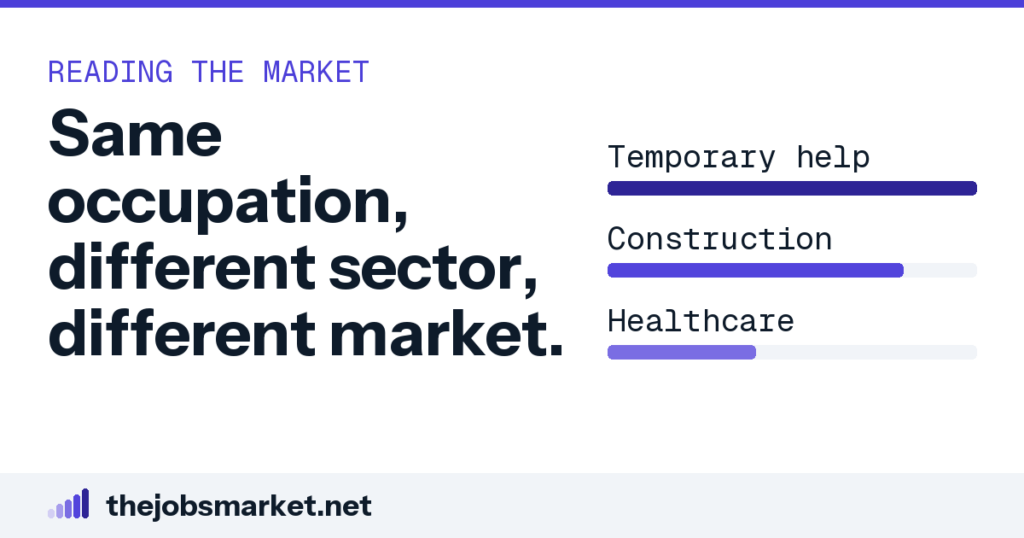
Job openings are published by industry as well as in total, and the sector composition moves even when the national figure does not. A flat headline can conceal healthcare expanding while information and professional services contract. For anyone deciding where to look, the industry breakdown matters far more than the total.
Why the national total hides the story
Total hiring can hold perfectly steady while the sectors doing it change completely. The aggregate is a sum, and a sum conceals everything happening underneath it. For anybody deciding where to look, the industry breakdown matters far more than the total ever will.
Two large sectors moving in opposite directions cancel each other out entirely. The resulting flat line gets reported as a market where nothing much is happening. That reporting is arithmetically correct and practically misleading.
A quarter in which healthcare expands strongly while information and professional services contract produces a boring national number. Underneath it there is a dramatic reshuffling of where the work is. The reshuffling is the part that affects you and it is the part the headline cannot show.
What to compare, and against what
Compare openings by industry against the same month a year earlier rather than against last month. That removes the seasonal pattern which otherwise dominates any short comparison. It is the single most important discipline when reading industry data.
Then compare each sector against its own history rather than against other sectors. Structural levels differ enormously for reasons with nothing to do with current conditions. A sector with permanently low openings is not necessarily a bad market, it may simply be one where people stay a long time. The trend within a sector is the signal and the level between sectors is noise.
The move most people never consider
A great many occupations exist across several industries at once. An accountant, an IT administrator, an HR specialist, a project manager or a data analyst is employed by hospitals, banks, manufacturers, universities and government alike. The occupation is the same in all of them.
Moving between sectors without changing occupation is one of the highest-leverage moves available to anybody. The same skills get priced by a sector that is currently hiring rather than by one that is not. Nothing about your capability needs to change.
It is also completely invisible if you search by job title alone. The title looks equally scarce everywhere, because the thing that changed was the sector behind it rather than the demand for the skill. Job boards organize by title, which is exactly why this move goes unmade.
Which sectors move with the cycle
Construction, manufacturing and temporary help are historically the most cyclical of the major sectors. Temporary help in particular tends to turn before the broader market does, in both directions. It is the adjustment mechanism employers reach for first when conditions change.
That makes it a useful leading indicator even if you never intend to work in it. Healthcare, education and government sit at the other end, driven by demography and appropriations rather than by demand. They pay less at the top and they do not disappear in a bad year. That trade is the whole proposition and it suits different people at different stages.
What a sector move actually costs
The cost is usually a story rather than a skill. The work is substantially the same and the vocabulary is not, so the barrier is convincing somebody that industry knowledge is learnable while your function transfers directly. That is a presentation problem rather than a capability problem.
The argument lands much better when the receiving sector is short of people, which is exactly the situation the openings data identifies for you. Making the same case to a sector with a deep pool of candidates is a considerably harder conversation. Timing does most of the work here and the data tells you the timing.
The pay consequence nobody mentions
The same occupation is priced differently by sector and the gap can be substantial. A function that is a cost center in one industry is a profit center in another, and pay follows that distinction rather than the job description. Nothing about the work itself explains the difference.
So a sector move is potentially a pay move in either direction, and people assume it is neutral. Check the published median for your occupation within the target industry before assuming a lateral move is genuinely lateral. That figure exists and takes a minute to find. Discovering it afterwards is an expensive way to learn the lesson.
How to run this before a search
List the industries your occupation actually exists in, which is usually more of them than you first think. Pull openings for each of those over two years. If one is expanding while another contracts, that is where your applications should concentrate.
The whole exercise costs about half an hour. It changes where you spend the next three months, which is a better return than almost anything else available before you start applying. Most people skip it and then wonder why the search feels unproductive.
A worked example
Say you are an IT administrator working in a professional services firm during a soft quarter for that sector. Your job title looks scarce everywhere you look, because you are searching for it inside the sector you already know. The conclusion feels obvious and it is wrong.
The same occupation exists in hospital systems, school districts, manufacturers, utilities and local government. Several of those are among the least cyclical employers in the economy. None of them is affected by whatever is happening to professional services this year.
The barrier is not skill and it is not credibility. It is that you would not have thought to look, because the boards organize by title rather than by who is buying. Half an hour with the industry openings data reorganizes the search around the second question, and the answer is usually somewhere you had not considered.
The one that catches people out
Moving into a sector while it is actively hiring is straightforward and the argument makes itself. Moving into one after the wave has passed is considerably harder. The same case that worked six months ago now lands on somebody with a full team and no budget.
Which is the argument for watching the data rather than reacting to the news. By the time a sector’s hiring is being written about, the easy part of the window has usually closed. Watching openings by industry once a quarter puts you a few months ahead of that, and a few months is the whole advantage.
Common questions
Why watch industry rather than the total?
Because sectors moving in opposite directions cancel out, and the flat total is reported as a market with nothing happening.
What comparison should I use?
Openings by industry against the same month a year earlier, then each sector against its own history rather than against other sectors.
Can I change sector without changing occupation?
Many occupations exist across several industries, so yes — and doing it when one sector is hiring is a high-leverage move.
Which sectors are most cyclical?
Construction, manufacturing and temporary help, which historically turns before the broader market in both directions.
Which are least cyclical?
Healthcare, education and government, driven by demography and budgets rather than by demand cycles.
Why watch industry rather than the national total?
Because sectors moving in opposite directions cancel out, so a flat total can hide a dramatic reshuffling underneath it.
Can I change sector without changing occupation?
Most occupations exist across several industries, so yes — and doing it while the receiving sector is hiring is one of the highest-leverage moves available.
Which sector is the best leading indicator?
Temporary help. It turns before the broader market in both directions because it is the adjustment employers reach for first.