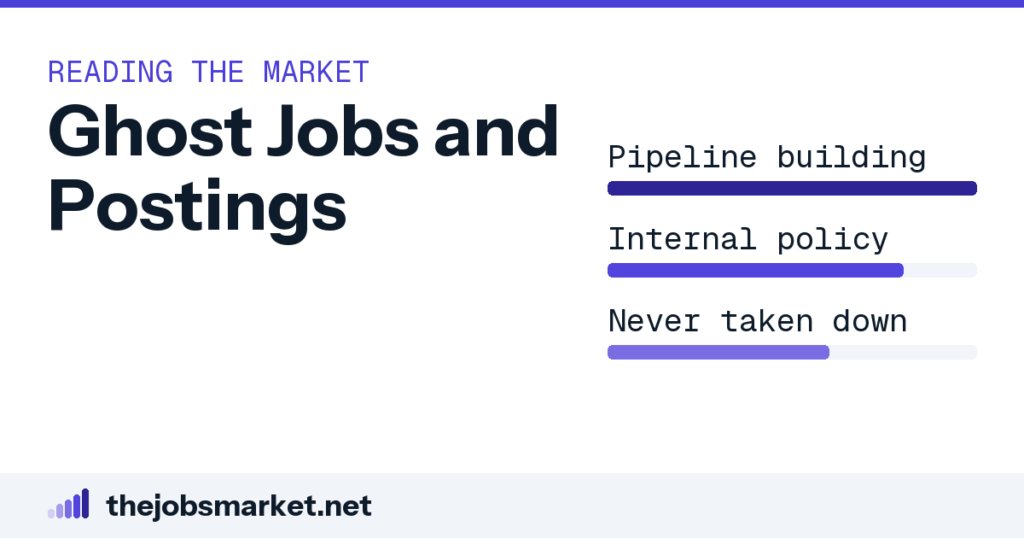
The official openings measure requires a position that exists, is unfilled, could start within thirty days, and is being actively recruited for. Many live postings meet none of those tests — kept up to build pipelines, satisfy internal posting policies, test the market, or simply never taken down. Treating job board volume as a measure of demand overstates it.
What officially counts as an opening
A posting is an advertisement and an opening is an intention to hire. Those are not the same thing, the gap between them has widened, and it explains a great deal of what a search feels like from the inside. Understanding the definition is the fastest way to stop taking silence personally.
The official measure requires four conditions at once. A position that exists, is currently unfilled, could start within thirty days, and is being actively recruited for. All four have to hold, which is precisely why the official count sits far below the number of listings visible on any given day.
That gap is not evidence of dishonesty by employers. It is the difference between a statistical definition designed to measure demand and a job board designed to collect applications. Both are doing their jobs. Only one of them is telling you how many roles are genuinely available.
Why postings persist without a job behind them
Pipeline building is the most common reason by some distance. Employers collect applicants for roles that may open later, and the applications are useful whether or not the position currently exists. Nothing about that requires bad faith and the effect on you is the same either way.
Internal posting requirements are the second. Many organizations must advertise externally even when an internal candidate has already been selected. That posting is completely genuine and completely unavailable to you. Neglect is third: a filled role whose listing was never taken down, because removing it requires somebody to remember and leaving it costs nothing.
Two more round it out. Aggregation means one role syndicated across several boards appears several times to anybody counting, inflating apparent volume without inflating opportunity. And frozen requisitions are roles that were approved, posted and then caught by a hiring freeze. Nobody removes those because they may unfreeze next quarter.
How to tell before you invest an hour
Check the original posting date on the employer’s own careers page rather than on the job board. Boards frequently refresh dates, so a role that looks four days old can easily be four months old. That single check filters more than any other.
Watch for the same role reposted repeatedly across months, which is the clearest pipeline signal available. Notice requirements that read as a wish list rather than as a job, because that usually means nobody has decided what the role actually is yet. Both of those are visible in thirty seconds.
Then ask the recruiter two questions directly. Is the position approved and funded, and when do you expect it to start. A real opening has straightforward answers to both. Hesitation on the first question is itself the answer you needed.
Why this matters beyond wasted applications
The real cost is that it distorts your read on the entire market. Somebody applying into a board full of stale listings concludes there is plenty of demand out there. The obvious next inference is that the problem must be them.
That conclusion is corrosive and it is frequently wrong. The official openings measure exists precisely because posting counts are unreliable as a proxy for demand. The gap between the two is widest when employers are cautious, which is exactly the moment when somebody searching most needs an accurate picture. The misinformation is worst when it hurts most.
Most postings are still real
The majority of listings are genuine and this is not an argument for giving up on job boards. The ones that are not cluster in particular employers, particular sectors and particular seasons rather than spreading evenly. That clustering is what makes filtering possible.
It is a reason to treat posting volume as a weak proxy for demand rather than a strong one. And it is a reason to spend your effort where the signals are good instead of spreading it evenly across everything a search result returns. Thirty considered applications beat two hundred scattered ones, and this is a large part of why.
The practical filter
Prioritize roles posted within the last fortnight on the employer’s own site rather than on an aggregator. Treat anything reposted across months as a pipeline unless a recruiter tells you otherwise. Weight a role with a named hiring manager and a specific team above one advertised by a generic account.
Then ask the two questions early rather than after three rounds of interviews. Recruiters answer them routinely and nobody thinks worse of a candidate for asking. It reads as somebody managing their time carefully, which is exactly what it is. The cost of asking is nothing and the cost of not asking is occasionally a month.
The one that is hardest to spot
The hardest case is a role that is genuinely open, genuinely funded, and already earmarked for somebody internally. The posting is real by every test above and you are still not going to get it. Nothing in the listing distinguishes it from a live opportunity.
There is no reliable way to detect this from outside, and it is common in organizations with internal-posting rules. The tell, when there is one, is a process that moves unusually fast to a single interview round and then goes quiet. A box has been ticked and the file is closed.
There is nothing to be done about it except refusing to read it as a verdict on you. Some proportion of every search gets spent on races that were decided before you entered them. Knowing that is the difference between a bad week and a crisis of confidence.
What the gap does to the published count
None of this affects the official openings figure, which is the useful thing about it. The survey asks employers directly about positions meeting all four conditions rather than counting listings anywhere. A stale posting on a job board does not enter that number at all.
So the two measures diverge for a reason and the divergence is informative. When board volume feels enormous while the official count is flat, you are seeing pipeline building and neglected listings rather than demand. Comparing what you see against what the survey reports is the fastest available correction to a misleading impression. It costs one lookup a quarter.
What to track about your own applications
Keep a simple record of four things. The date applied, whether the posting was on the employer’s own site, how long it had been live, and what eventually happened. That is one row in a spreadsheet and it takes seconds.
After about thirty applications you will have your own data on which sources actually convert for you. Most people discover the same pattern, which is that a small number of well-chosen applications to fresh employer-site postings outperform a large number scattered across aggregators. It is worth knowing that from your own numbers rather than taking anybody’s word for it. Your field may be the exception and only your record will show it.
Common questions
What officially counts as an opening?
A position that exists, is unfilled, could start within thirty days and is being actively recruited for.
Why do postings stay up when the role is filled?
Because removing them costs effort and leaving them costs nothing. Pipeline building and internal posting policies also keep roles live.
How can I tell before applying?
Check the original date on the employer's own careers page, watch for repeated reposting, and ask whether the role is approved and funded.
Are most postings fake?
No. The majority are real, and the unreal ones cluster in particular employers and seasons. Posting volume is simply a weak proxy for demand.
Why does this distort my view of the market?
Because a board full of stale postings looks like plenty of demand, which makes an unsuccessful search feel like a personal failure.
What officially counts as a job opening?
A position that exists, is unfilled, could start within thirty days and is being actively recruited for. A posting alone meets none of those tests.
Why do postings stay up after a role is filled?
Removing them requires somebody to remember and leaving them costs nothing. Pipeline building, internal posting rules and frozen requisitions keep others live.
What two questions should I ask a recruiter?
Is the position approved and funded, and when do you expect it to start. A real opening has answers to both.