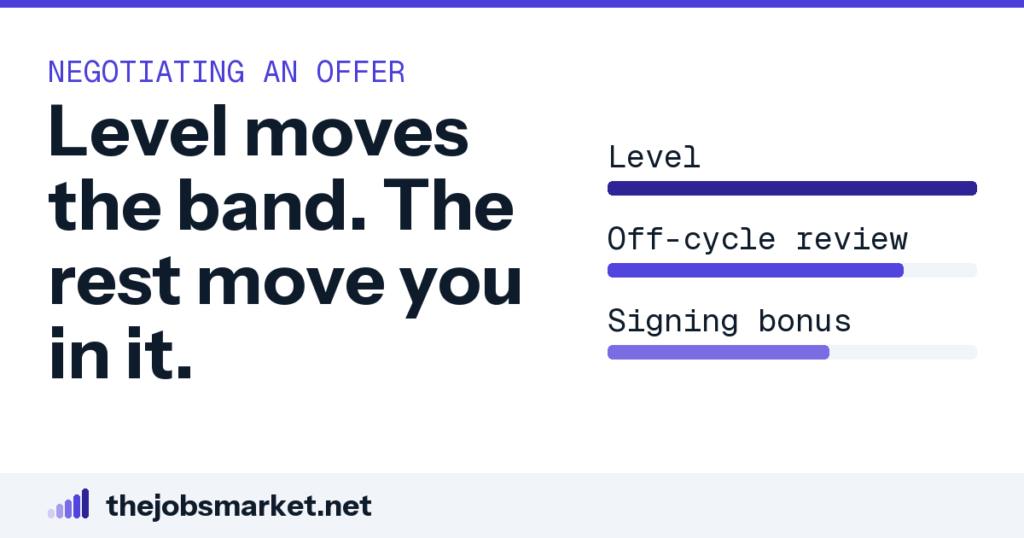
Where base is fixed by a band, employers can usually move a signing bonus, a start date, an off-cycle review, remote or hybrid arrangements, additional leave, equity, and occasionally the level itself. The level is the one worth pushing hardest on, because it moves the band rather than your position inside it — and everything else follows from the band.
Why the non-cash terms are the underused ones
The recruiter says the number is fixed, and most candidates hear that as the end of the negotiation. It is the end of one negotiation and the start of several others that are usually easier to win. Base sits inside an approved band, and moving it may require an exception somebody has to justify upward. Several other terms cost the employer far less, disturb nobody else’s pay, and are decided by the person you are already talking to.
Which is exactly why they are frequently granted and almost never requested. Most candidates negotiate one line and treat everything else on the page as fixed. The offer letter has a dozen terms in it and only one of them is the subject of the conversation. That imbalance is the opportunity.
The level is the one that moves the band
Everything else on this list moves you inside a band. The level moves which band you are in, which is a different order of magnitude entirely. A role advertised at the top of one level, when your experience matches the level above, is a level conversation rather than a salary one. Winning it changes your base, your bonus percentage, your equity target and every future increase at once.
Test it before you ask. In pay transparency states, read what this employer advertises for the level above and see whether your experience clears what those postings require. If it does, the ask is specific and factual rather than aspirational. Say that the scope described in the interviews matches the higher posting, and ask whether the role can be leveled there.
It will not always be available, because levels carry internal equity consequences that a signing bonus does not. But it is asked for so rarely that people assume it is impossible. Ask this one first, before anything else, because a yes makes most of the rest of the conversation unnecessary.
The ones with real money attached
The start date relative to a vesting event is the most underrated financial term in any offer. Moving it by a few weeks can carry you past a tranche worth more than the entire base increase you were arguing about. Work out your own vesting dates before the conversation rather than during it. This is arithmetic you can do in ten minutes and it frequently changes what you should ask for.
A sign-on bonus to bridge forfeited equity is the standard companion to that. Bring the actual figure and date rather than a general statement, because a specific forfeiture is negotiable in a way a vague one is not. Naming the amount vesting in March and the date it lands gives the recruiter something concrete to request. The employer retirement contribution is occasionally flexible for senior roles and is worth a compounding percentage of salary. The health premium share, for a family, can run to several thousand dollars a year on its own.
The ones that cost little and matter daily
Additional paid leave is worth about $385 a day on a $100,000 salary, which makes five extra days close to a two percent raise you take in time instead of cash. Remote or hybrid arrangements should be in writing rather than held as a verbal understanding. Schedule flexibility costs nothing and is decided locally. None of these require an exception to anything.
A defined review at six months, with written criteria, is the most underrated item on the whole list. It converts a refusal now into a date and a standard you can actually meet. That is far better than an assurance that things will be looked at later, which reliably evaporates when the manager changes. Ask for the criteria in the same sentence as the date, because a review with no standard is just another conversation.
Terms that shape your next few years
Title affects how the market reads you when you next move, and it costs the employer nothing to get right. Scope and reporting line affect what you can actually do once you arrive, which decides whether the next promotion is available at all. A training or certification budget is worth asking for when it is tied to a credential employers advertise for by name. All three shape your position long after the starting salary stops mattering.
Relocation support belongs here too, where it is relevant, and the tax treatment of it is the part to ask about. Employer-paid relocation is taxable wages for civilians, so a generous-sounding package can be considerably less generous once it is grossed up or, more often, not grossed up. Ask specifically whether the figure is before or after tax. That single question has been worth thousands to people who asked it.
The restrictive terms worth negotiating away
Non-compete scope and duration vary enormously in enforceability from state to state, and the version in your offer was written for the strictest case. Non-solicit clauses are frequently broader than people expect and can reach colleagues you had nothing to do with recruiting. Non-disparagement should be mutual rather than one-sided, and asking for that is normal. None of these cost the employer anything today.
They do constrain you for a year or more afterwards, which is why they are worth attention now. They are also far easier to change before signing than at any point after. Once the contract is executed, the leverage that made the whole conversation possible is gone. Read those clauses before the salary discussion rather than after it.
How to ask for several things at once
Name two or three items, with a reason for each, in a single message. Do not present a list of eight, because that reads as a negotiation rather than a request and invites a blanket decline. Three is enough to give the employer somewhere to say yes without feeling surrounded. It also signals that you have thought about priorities rather than asking for everything.
Rank them privately before you write. If you win the top item and lose the others, that is a good outcome you should recognize as one. Knowing your order also stops you spending goodwill on the least valuable thing on the list. People routinely win the item they cared about least because it was the one they argued hardest for.
Get it in the offer letter
Anything agreed verbally and not written down does not survive the departure of the person who agreed it. That applies with particular force to remote arrangements, review commitments and any pay protection tied to a location. Managers change, policies change, and the only thing that persists is the document. Asking for the document is not distrust, it is administration.
Asking is also normal, and reluctance is informative. An employer comfortable with a commitment documents it without much discussion. An employer who resists putting something in writing is telling you what that commitment is actually worth. Treat that answer as data about the role rather than as an obstacle to get past.
The order to work in
Ask about the level first, because it moves the band and nothing else does. If the level is settled, base comes next, since every future increase, bonus percentage and retirement contribution is calculated from it. A gain there compounds for as long as you hold the job and follows you to the next one. Everything else on this page moves you inside a structure those two decisions set.
Then work down the list once you have established the band is genuinely fixed, which you establish by asking where in the range the offer sits. That question comes before the requests rather than after them. Getting the order right is most of the skill here, and it is the part nobody explains.
Common questions
What is worth negotiating besides base?
Level first, because it moves the band rather than your place in it. Then a signing bonus, an off-cycle review, start date, remote arrangements and additional leave.
Why is an off-cycle review undervalued?
It converts a no into a delayed maybe with a date, and it costs the employer nothing today — which is exactly why it is often available when base is not.
Is a title worth negotiating?
Only if it comes with the level. A title alone costs the employer nothing and is worth nothing, because levels are internal grammar and do not travel.
How many things should I ask for?
Two, in priority order. A list of six reads as a list rather than a negotiation and invites the cheapest item on it.
Do these need to be in writing?
Yes, all of them. An off-cycle review in particular is worthless as an understanding and valuable as a sentence in the offer letter.
What is negotiable besides salary?
Start date relative to vesting, a sign-on bridging forfeited equity, retirement contribution, health premium share, leave, remote arrangements, title and review timing.
Which non-cash term is most underrated?
A defined review at six months with written criteria. It turns 'we cannot move now' into a concrete date and standard.
How many things should I ask for?
Two or three, each with a reason, in one message. A list of eight invites a blanket decline.