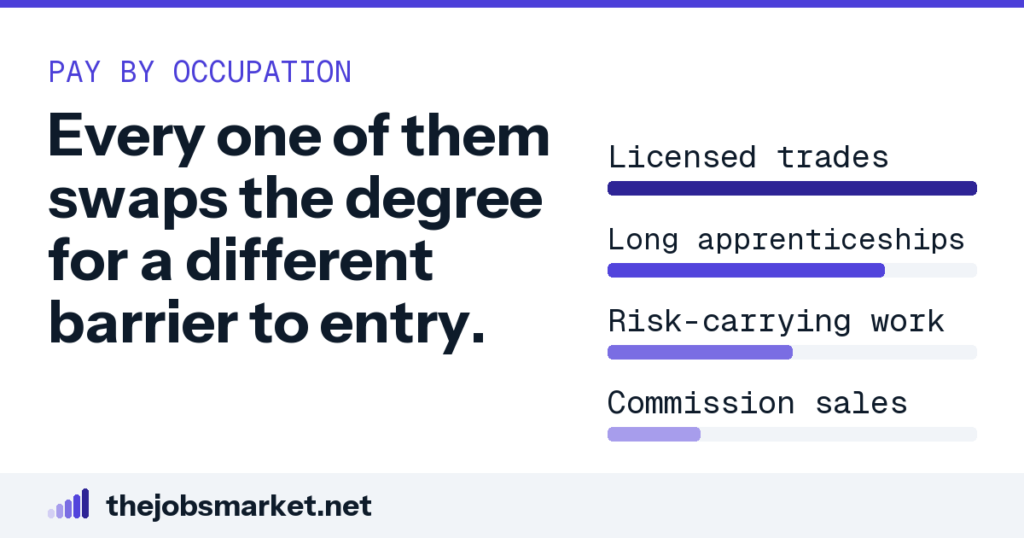
The top of the published pay tables is almost entirely medicine, and the highest-paid occupation with no degree requirement is commercial pilot. Across occupations with fifty thousand or more workers, only three no-degree occupations clear the bachelor's-entry median of $97,550: commercial pilots at $123,220, transportation and storage managers at $107,230, and first-line supervisors of police and detectives at $106,040. Each substitutes a license, an apprenticeship or accumulated risk for the credential.
The top of the table is medicine, then aviation
Sort published occupational medians and the top of the list is monotonous. Physicians of various kinds occupy most of it — physicians all other at $265,930, internal medicine at $256,560, family medicine at $244,180 — followed by nurse anesthetists at $236,590. Four of the top five entries are clinical medicine of some kind.
Then aviation appears. Airline pilots sit at $232,140, which puts them among the highest-paid occupations in the country and is the first entry on the list that does not require a medical degree. Chief executives follow at $213,990.
That ordering is worth noticing before any argument about credentials begins. The very top of the American pay distribution is dominated by occupations gated behind long, expensive, heavily regulated training, and the exceptions are few enough to name individually. That is unusual for any list covering several hundred separate occupations.
Where the exception sits
The useful comparison is not against the physicians but against the bachelor’s-entry median, which is $97,550 across occupations grouped by typical entry education. Beating that figure without a degree is the genuinely interesting question. Everything above that line is medicine and aviation almost exclusively.
Restricting to occupations with fifty thousand or more workers, only three no-degree occupations clear it. Commercial pilots at $123,220, transportation, storage and distribution managers at $107,230, and first-line supervisors of police and detectives at $106,040. All three sit within thirty thousand dollars of the bachelor’s median figure.
Three, out of hundreds of occupations. That is the honest scale of the exception, and it is considerably narrower than the genre of article promising well-paid careers without a degree usually implies to a reader. The category is entirely real and it is also very small.
What the well-paid no-degree occupations share
None of them is open in the way the phrase “no degree required” suggests, and the pattern across all of them is remarkably consistent. Each one closes a different door in place of the degree.
Every one substitutes a different barrier to entry. Commercial pilots need certification, medical clearance and a large number of logged flight hours, most of which have to be paid for before anybody employs you. The supervisory roles require years inside the occupation first, so the entry requirement is displaced rather than removed.
Licensed trades work the same way — an apprenticeship of several years, a licensing exam, and in many states continuing education to maintain it. Risk-carrying work pays a premium for the risk itself, and commission-heavy sales pays a premium for accepting volatility in your own income from month to month. That volatility is itself the thing being compensated for.
The unifying point is that pay follows scarcity, and a credential is only one way to create it. Time, licensure, risk tolerance and income volatility are the others, and each of them is a real cost paid by the person doing the job. None of these routes is genuinely free of a barrier.
The cost side nobody puts in the table
A median wage figure describes earnings and says nothing about what was spent to reach them. For the no-degree occupations that cost is frequently substantial and it is paid up front by you. Nobody advances the money for flight hours or licensing exams.
Flight training runs to a large sum before anybody is employable, and the early years of a flying career are often at regional carriers paying far below the headline. An apprenticeship pays while you learn, which is a genuine advantage, and it also pays considerably less than the licensed rate for several years running. That difference in pay is effectively the price of the training.
The degree side has its own cost and it is better documented, which is part of why the comparison feels lopsided. Both routes involve years of reduced or negative earnings, and the honest comparison prices both rather than treating either route as free. Both of them involve years of reduced or negative earnings.
Where degrees genuinely pay
The education ladder is real and it is worth stating plainly, because the exceptions above are not an argument against it. Occupations by typical entry education run: no credential $35,660, high school $47,700, postsecondary certificate $50,620, associate $66,120, bachelor’s $97,550, doctoral or professional $136,570 at the very top. The ladder is steep and it is entirely real.
The gap between the high school figure and the bachelor’s figure is roughly double, and it applies to tens of millions of workers on each side rather than to a handful of occupations. That is a much larger fact than any individual exception to it. Tens of millions of workers sit on each side of that gap.
One entry breaks the pattern and it is worth explaining rather than hiding. The master’s-entry median is $78,620, below the bachelor’s figure, and that is real rather than an error. Master’s-entry occupations concentrate in education, counseling, social work and library science, while bachelor’s-entry includes registered nurses at $97,550 alongside technical and management work. The field sets the pay rather than the credential level.
The middle of the market
Between the exceptions and the ladder sits where most people actually work, and it is worth looking at directly. Four of the six largest occupations in America pay under $38,000: home health aides at $35,800 with over four million workers, retail salespersons at $35,410, fast food at $31,200, and cashiers at $32,880. Those four occupations alone employ well over twelve million people.
General and operations managers at $105,770 and registered nurses at $97,550 are the two large, well-paid exceptions, and both are bachelor’s-entry occupations employing several million workers each. Both of them required the credential in order to enter.
That distribution is the context any highest-paying list omits. The top of the table describes a small number of people, and the shape of the labor market is decided by the occupations at the other end of the table. That is where most working lives in America actually happen.
How to read a highest-paying list at all
Check the employment count beside every figure. An occupation paying $200,000 with four thousand workers nationally is a fact about a small profession rather than an available career path, and lists frequently mix those in without any comment at all. Employment counts are published alongside every single wage figure.
Check what the education requirement actually means. Published categories describe the education typically needed to enter an occupation, not what people in it hold, and the two diverge in both directions — general and operations managers “need” a bachelor’s and 46.9 percent of them actually hold one. The stated requirement and the reality diverge in both directions.
Then ask what barrier replaces the degree, because there is always one. If a list names an occupation as requiring no degree and does not mention the license, the apprenticeship, the hours or the risk, it has left out the part that decides whether you can actually do it.
Common questions
What are the highest-paying occupations?
Mostly medicine — physicians all other at $265,930, internal medicine at $256,560, family medicine at $244,180, nurse anesthetists at $236,590 — then airline pilots at $232,140 and chief executives at $213,990.
Which no-degree occupations beat the bachelor's median?
Among those with 50,000+ workers, only three clear $97,550: commercial pilots at $123,220, transportation and storage managers at $107,230, and first-line supervisors of police and detectives at $106,040.
What do those occupations have in common?
Each substitutes a different barrier — a license, logged flight hours, years inside the occupation, accepted physical risk, or income volatility. Pay follows scarcity, and a degree is only one way to create it.
What does the education ladder look like?
By typical entry education: no credential $35,660, high school $47,700, certificate $50,620, associate $66,120, bachelor's $97,550, doctoral or professional $136,570.
Why is the master's figure below the bachelor's?
Because master's-entry occupations concentrate in education, counseling and social work, while bachelor's-entry includes registered nurses at $97,550 plus technical and management roles. The field sets the pay.
What cost is missing from these tables?
What was spent to get there. Flight training is paid up front and early flying years pay far below the headline; apprenticeships pay while you learn and pay well below the licensed rate for years.
What does the middle of the market look like?
Four of the six largest occupations pay under $38,000 — home health aides at $35,800, retail at $35,410, fast food at $31,200 and cashiers at $32,880.
How should I read a highest-paying list?
Check the employment count beside each figure, check what the education category actually means, and ask what barrier replaces the degree — there is always one.