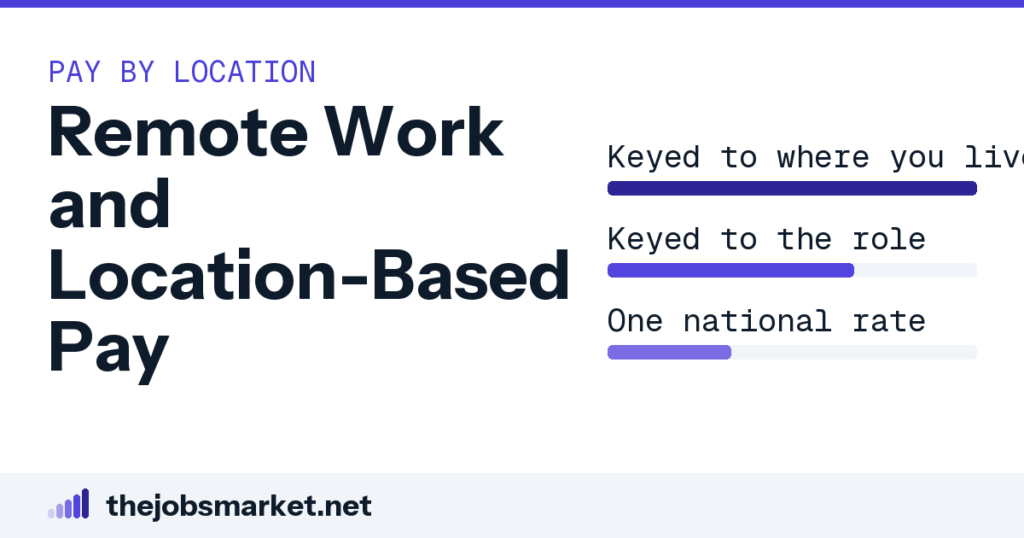
Most employers hiring remotely still set pay against a location band. What differs is which location it is keyed to — where you live, where the role is anchored, or a single national rate — and what happens if you move. Those three policies produce very different outcomes for the same person, and the difference is a policy question with a factual answer rather than a matter of negotiation.
Three policies, very different numbers
You take a fully remote job and assume geography has stopped mattering to your pay. It has not, and the question you should have asked in the interview is which geography your employer keys the number to. Three answers are common, they produce very different outcomes for the same person, and each one is a written policy rather than a negotiating position. Finding out which applies takes one question.
The first is pay keyed to where you live. The role is priced against your local market, so moving somewhere cheaper triggers an adjustment downward, and moving somewhere expensive may or may not trigger one upward. This is the most common arrangement at larger employers and the one with the most asymmetry built into it. The adjustment usually happens from the date you register the new address.
The second is pay keyed to the role rather than to you. The job is anchored to a market, often the headquarters or the market it was originally scoped against, and your own location does not enter the calculation. This is the best of the three for most people, because it lets you take an expensive market’s rate and live wherever you like. It is also the one employers advertise least.
The third is a single national rate. The employer prices the work by what it is worth to the business, wherever the person sits, and applies one number everywhere. It is the simplest to administer and the easiest to defend internally. It is better than location-indexing for anybody outside an expensive metro and worse for anybody inside one.
The argument each side makes
Employers indexing by location argue they are matching the market you actually compete in. If local employers pay less for your work, they see no reason to pay more, and they can point at published data to support it. That argument is coherent and it is also convenient, since the adjustment nearly always runs downward in practice. Both things are true at once.
Employers paying one rate argue they are buying the same output regardless of geography. They also argue that indexing penalizes people for a housing market they did not create and cannot control. Administratively it is far simpler, which matters more in these decisions than most people assume. Neither position is obviously right, and what matters to you is knowing which one you are under.
The questions to ask before accepting
Ask whether pay is indexed to your location or set nationally, and ask it plainly rather than hinting at it. Ask what happens if you move, and specifically whether the adjustment runs in both directions or only one. Ask which tier your location sits in and where the tier boundaries fall. All three are policy questions that a well-run employer answers without hesitation.
Ask before signing rather than after, because the answer changes what the job is worth. An arrangement that reduces pay when you relocate is a materially different job from one that does not, even at the same starting number. It also constrains a decision you may want to make in three years. Nobody minds the question at offer stage and everybody minds it afterwards.
Why remote work did not flatten pay
The obvious prediction was that remote hiring would erase geographic differences within a few years. It largely has not, and concentration is the reason. A dense market is not simply a lot of jobs in one place, it is employers competing with each other, colleagues who compare notes, and a locally known rate for the work. None of that disappears when an office closes.
A company hiring remotely into San Jose is still hiring against San Jose employers for that person. The competition is what sets the price, and the competition is still local even when the work is not. Registered nurses run 5.79 times across metros and software developers concentrate 3.68 times over the national rate in Boulder. Those patterns are about where employers are, and remote work moved the desks rather than the employers.
Where the wage data cannot help you
Published occupational wages are recorded by establishment location rather than by where the worker actually sits. So the geography in every wage table is employer geography, and for heavily remote occupations that gap has been widening every year. The table cannot see a developer in Montana working for a company in Seattle. It records that job in Seattle.
Read a metro median for a remote-heavy occupation as what employers headquartered there pay. That is still the number you would negotiate against, which makes it useful. It is not a statement about living standards in that city, and treating it as one produces confused conclusions. The distinction matters most in exactly the occupations where remote work is most common.
The tax complication
Working remotely across a state line raises the question of which state may tax the income. A few states apply rules that treat you as working at the office regardless of where you actually sat, which reverses the usual answer. The temporary arrangements that softened this during the pandemic have largely lapsed. Anybody still relying on a 2020 understanding is working from rules that may no longer apply.
This area is genuinely unsettled and the answer depends on the specific pair of states. It is one of the few situations where paying for an hour of professional advice before accepting is straightforwardly worth the money. Your employer’s payroll department can tell you what they intend to withhold, which is a useful starting point. What they withhold and what you owe are not always the same thing.
The strategy that actually works
Get hired at a national rate, or at the rate of an expensive market, and then decide where to live. That sequence is worth more than any negotiation over a few percent, and it is only available before you sign. Once you are inside a location-indexed structure, moving becomes a repricing event rather than a personal decision. The order of operations is the whole strategy.
Employers who index will usually say so early, because it is policy rather than a position they are taking with you. Employers who do not index rarely advertise the fact, which means it is worth asking directly rather than assuming the worst. A surprising number of smaller employers have never formalized a policy at all. In that case getting the arrangement written down is the entire task.
If you are already remote and considering a move
Get the policy in writing before you commit to anything, including a lease or a sale. A verbal assurance from a manager does not survive that manager leaving, and pay policy is among the first things a new leadership team revisits. An employer comfortable with the arrangement will document it readily. Reluctance to write it down is itself the answer you were looking for.
Then check what your occupation pays in the destination anyway, before assuming indexing is bad news. If the local market pays more than your current rate, indexing is an opportunity rather than a risk. That reversal is more common than people expect, particularly in small metros with an anchor employer. The policy only matters once you know which direction it would push you.
Common questions
Do remote employers really still use location bands?
Most do. What varies is whether the band follows where you live, where the role is anchored, or a single national rate — and those produce very different outcomes for the same person.
Will my pay drop if I move somewhere cheaper?
Under a live-where-you-are policy, usually yes. Note the asymmetry: many employers adjust downward on a move to a cheaper area without adjusting upward for the reverse, so ask about both directions.
Why do employers care which state I live in?
Payroll registration, tax withholding, employment law and insurance all follow the employee's location, and each state carries real administrative cost. That is why approved-location lists exist even at national-rate employers.
Which policy is best for me?
A band keyed to an expensive anchor while you live somewhere inexpensive. It is also the one most likely to be revisited, so ask whether the policy is written down.
Has remote work flattened pay geography?
For roles already priced in a national market, substantially. For anything requiring presence, licensure or local knowledge, barely at all.
Do employers pay remote workers by location?
Some index pay to where you live; others set a single national rate. Both are common and the difference can be a large fraction of salary for identical work.
Why didn't remote work flatten geographic pay?
Dense markets are employers competing with each other and a known local rate, and those survive the office closing. A company hiring remotely into San Jose still hires against San Jose employers.
What should I ask before accepting a remote role?
Whether pay is indexed to location, what happens if you move, and which tier your location sits in — in writing, before signing.