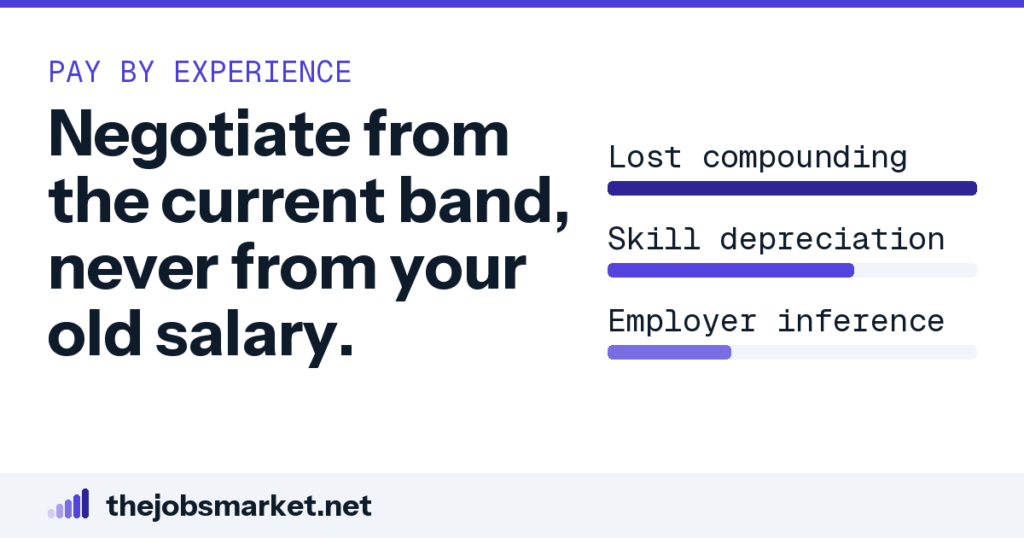
No published US source tracks earnings before and after a career break, so anybody quoting a precise penalty is estimating. What the structure of pay tells you is clear enough: percentage raises compound, so time out removes the multiplier rather than a year of income, and returning at a previous salary locks that loss in permanently. The single most valuable thing you can do is negotiate from the current band for the role rather than from what you earned before.
What the published data can and cannot tell you
Be skeptical of any specific penalty figure you find for career breaks, because the data to produce one reliably does not exist in US public statistics. The main occupational wage survey is an establishment survey — it asks employers what jobs pay, not what individual people earned across their working lives — so it carries no employment history at all. Nobody in that dataset has a past or a future.
That means there is no published series tracking the same people before a break and after one. Figures that circulate come from academic panel studies with particular samples and periods, or from private datasets with their own selection issues, and they vary widely for exactly that reason. Treat any single figure with real caution.
What can be said with confidence is structural rather than statistical, and it is more useful anyway. We know how pay is administered, we know raises are percentages, and we know what returning at a previous salary does over a decade. That reasoning does not need a penalty estimate to be actionable.
Why the gap persists after you return
Three mechanisms operate and they are worth separating, because only one of them is really about you. The other two are arithmetic and market structure.
The largest of the three by some distance is lost compounding. Pay increases are calculated as percentages of current pay, so every year out is a year the multiplier did not apply, and the effect does not stop when you return — the gap between your salary and where it would have been grows for the rest of your career unless something resets it. That is arithmetic rather than judgment about your capability.
The second is skill depreciation, and its size depends enormously on the field. In areas where tools and practices turn over quickly, two years away is a genuine gap that needs addressing. In areas where the underlying expertise is stable — most professional judgment work, much of management, many regulated fields — the depreciation is far smaller than employers sometimes assume.
The third is employer inference, which is the one people find hardest to hear. Some employers read a gap as a signal about commitment or currency, and while that is often unfair and sometimes unlawful, it exists and it affects offers. Knowing it exists is what lets you address it directly. Hoping it goes unnoticed is the strategy that reliably fails.
The single most valuable thing to do
Negotiate from the current band for the role rather than from your previous salary. That one decision does more than anything else in this article, because it is the mechanism that locks the loss in permanently or breaks it. One conversation genuinely decides which of those happens.
If you return at your old number, you have accepted a figure set before the break, and every subsequent percentage raise compounds from there. If you return at the current market rate for the work you will actually do, the break costs you the earnings you missed and nothing beyond that. Everything else compounds from the new number.
Salary history bans help substantially here, and this is the group they were most clearly designed for. In many states and cities an employer cannot ask what you previously earned, which removes the anchor from the conversation entirely — and even where they can ask, you are not obliged to volunteer it. Anchor the conversation on published ranges for the role instead.
Where the market is most forgiving
Some fields treat breaks as unremarkable, and it is worth knowing whether yours is one before assuming the worst. Occupations with formal credentials that remain valid tend to be forgiving, because the credential does the vouching rather than continuous employment. The credential is doing the vouching on your behalf.
Fields with genuine shortages are forgiving for straightforward economic reasons — an employer struggling to fill a role is not in a position to be selective about employment gaps. Healthcare, skilled trades and teaching have all had periods of exactly that dynamic recently. Shortage makes employers considerably less interested in gaps.
Public sector and large-employer hiring processes tend to be more structured and more rules-based, which frequently works in favor of somebody returning. A defined band and a scored process leave less room for the inference problem than an unstructured conversation does. A scored process is harder to apply an impression to.
Where it is hardest
Fast-moving technical fields are hardest, and the difficulty is partly real. Where tooling turns over every eighteen months, a three-year gap is a genuine currency problem rather than a perception one, and the answer is to close it visibly rather than to argue that it does not exist. Currency in a field is demonstrated rather than asserted in an interview.
Roles where progression is tightly tied to continuous tenure are also difficult, because the structure itself assumes an unbroken sequence. And highly competitive fields with many applicants per role give employers room to use a gap as a filter simply because they can afford to. Abundant applicants make every filter cheaper to apply.
In each of those cases the productive response is the same: make the currency visible. A recent project, a current credential, contract or part-time work in the field, or a portfolio piece dated this year does more than any explanation of the gap itself. Recent evidence beats reassurance every time here.
How to handle the gap in the conversation
Address it briefly, factually, once, and move on. A long explanation invites more questions than it settles, and an apologetic tone suggests there is something to apologize for when there is not.
What works is a short, matter-of-fact sentence followed immediately by what is current: “I took two years out for family reasons and have been back on contract work since March — most recently on X.” That answers the question and redirects to the present, which is where you want the conversation. Everything after that sentence should be about the work.
Do not volunteer your previous salary at any point in the process. It is the anchor that does the damage, and in many jurisdictions the employer cannot even ask for it. If pressed, redirect to the range for the role — that is a legitimate answer and a common one.
The re-entry route that works
The most reliable route back is a stepping-stone rather than a direct return at the previous level. Contract work, a fixed-term role, a returnship where one exists, or a position slightly below your previous level with a clear path upward all do the same job: they replace an explanation with a recent and verifiable record. That is a much easier thing to evaluate than an absence.
The reason this works is that the second employer is not evaluating a gap at all — they are evaluating current work. Six months of recent employment converts the conversation from one about absence into one about what you have just been doing instead.
The risk to manage is accepting a level that becomes permanent. Take the stepping stone with an explicit understanding about progression, and treat it as a route rather than a destination, with a specific date attached to reviewing the level. Otherwise the stepping stone quietly becomes the destination.
What to check before accepting a return offer
Check the offer against the published range for the role in your area rather than against what you used to earn. Those are different questions and only the first of them matters to this decision.
Ask what the band is for the level you are being hired into and where in it your offer sits, which in several states you are entitled to be told. If the offer sits at the bottom of a band for work you can already do, that is worth raising before you accept. After signing, the same observation carries far less weight.
And ask for a dated review — three or six months, with a specific figure or range attached and confirmed in writing. Employers are frequently willing to agree to a review for somebody returning even where they will not move the starting number, and it is the mechanism that stops a cautious opening offer becoming your permanent level.
Common questions
How big is the career break pay penalty?
No published US source tracks earnings before and after a break, so any precise figure is an estimate. The main wage survey is an establishment survey and carries no employment history at all.
What actually causes the gap?
Three things: lost compounding, which is the largest and is pure arithmetic; skill depreciation, which varies enormously by field; and employer inference about gaps, which is real even where it is unfair.
Why does compounding matter most?
Because raises are percentages of current pay. Every year out is a year the multiplier did not apply, and the gap keeps growing after you return unless something resets it.
What is the single most valuable thing to do?
Negotiate from the current band for the role rather than from your previous salary. That decision either locks the loss in permanently or limits it to the earnings you actually missed.
Do salary history bans help?
Substantially, and returners are the clearest beneficiaries. In many states and cities an employer cannot ask what you earned before, and even where they can, you need not volunteer it.
Which fields are most forgiving?
Those with credentials that stay valid, those with genuine shortages, and structured public sector or large-employer processes where a defined band leaves less room for inference.
How should I explain the gap?
Briefly, factually, once — then redirect to what is current. A long explanation invites more questions than it settles and an apologetic tone implies there is something to apologize for.
What is the best route back?
A stepping stone — contract work, a fixed-term role, or a returnship. The next employer evaluates recent work rather than a gap, but agree progression with a date so the level does not become permanent.