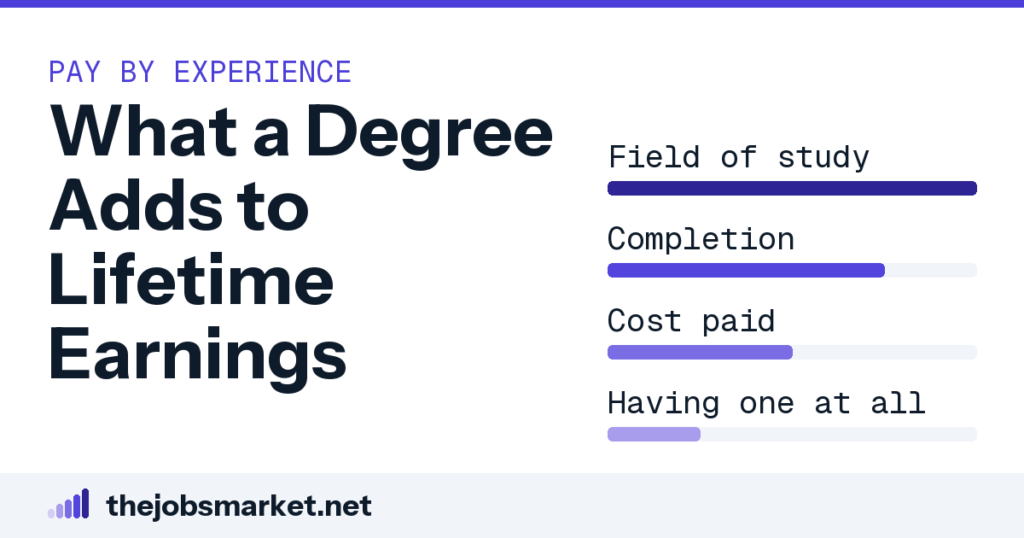
Across a working life, people with a bachelor's degree earn substantially more on average than those without one. But the average hides enormous variation by field, by whether the degree is finished, and by what it cost — and it is a correlation across a population rather than a prediction about an individual. The useful question is not whether degrees pay but whether this degree, at this price, in this field, pays.
What the occupational data can and cannot answer
Somebody quotes you a lifetime earnings figure for a bachelor’s degree, usually a round number in the millions, and it settles the argument. It should not, because that figure is an average across a population that differs from you in dozens of ways besides education. The useful question is never whether degrees pay. It is whether this degree, in this field, at this price, pays for the person considering it.
Grouping occupations by the education typically needed to enter them, and weighting by how many people work in each, gives a clear ladder. No credential comes in at $35,660, high school at $47,700, a postsecondary certificate at $50,620, an associate degree at $66,120, a bachelor’s at $97,550, and doctoral or professional work at $136,570. The distance from the bottom of that ladder to the bachelor’s rung is $61,890 a year, which is a serious number and worth taking seriously. It is also not quite what most people think it is.
Be precise about what those figures describe. They describe the occupations that typically require each level of education, not the earnings of the people who hold each credential. Somebody with a degree working in a high-school-entry occupation appears in the lower bucket, and a great many graduates do exactly that. The ladder measures the jobs, and you are choosing a job as much as a credential.
The inversion worth explaining
Occupations typically requiring a master’s degree show a weighted median of $78,620, which is $18,930 below the bachelor’s figure of $97,550. That looks like an error and it is not one. Master’s-entry occupations are concentrated in education, counseling, social work and library science, all of which pay modestly. Bachelor’s-entry occupations include registered nurses at $97,550 alongside a large block of technical and management work.
The lesson generalizes well beyond that one comparison. The credential level is not what sets the pay; the field does, and the field is chosen years before anybody looks at a salary table. Two people with the same degree from the same institution can end up in occupations that differ by a factor of three. That is why the field of study belongs at the top of any honest ranking of what matters.
The factor that decides more outcomes than any other
Between field, completion, cost and simply having a credential, completion is the one that turns a good investment into the worst available outcome. Starting a program and not finishing it means paying the cost and receiving none of the credential. There is no partial credit in the wage tables, and an unfinished degree does not move you into the higher bucket. The debt, however, behaves exactly as it would have if you had graduated.
That makes an institution’s completion rate part of the return calculation rather than a separate quality concern. Institutions publish graduation rates, and the Department of Education’s College Scorecard collects them alongside program-level earnings and debt. Look at the rate for the program you are entering rather than the headline figure for the school. A program where a large share of entrants do not finish is quietly a different bet from the one being advertised.
The costs the ladder does not show
Tuition is the visible cost and rarely the largest one. Years of forgone earnings usually exceed it for anything longer than a certificate, and no tuition figure includes them. There is also the compounding those forgone years would have produced in retirement contributions, which nobody puts on a brochure. A full accounting has three lines, and most conversations only ever have one.
Work an example through. A two-year master’s costing $60,000 in tuition, taken by somebody currently earning $55,000, costs $170,000 once the forgone salary is counted. If it raises pay by $12,000 a year, the break-even point arrives after about 14 years. That may still be worth doing, but it is a very different decision from the one implied by comparing two salary figures.
The same arithmetic explains a comparison people make badly in the other direction. An electrician earning $63,190 was being paid throughout the apprenticeship, while a physician reaching $244,180 spent roughly a decade paying to train and earning little. Comparing peak salaries ignores the entire first act of both careers. The honest comparison is lifetime, and it narrows considerably.
Where no degree beats the average degree
Three occupations with fifty thousand or more workers require no degree and pay above the bachelor’s-level median. Commercial pilots have a median of $123,220, transportation and distribution managers $107,230, and first-line supervisors of police and detectives $106,040. The pilot figure is 1.26 times the bachelor’s-entry median, which is not a rounding difference. These are not obscure jobs, and none of them requires a four-year degree to enter.
Below that threshold, plenty more clear $60,000 without a degree in the picture. Industrial machinery mechanics reach $64,520, electricians $63,190, heating and air conditioning technicians $61,010. Each of those sits about $15,000 above the high-school-entry median, and each has a genuine gate in front of it. The gate is an apprenticeship, a license with logged hours, or years of supervised training.
Why the gate matters more than the diploma
What raises pay is constrained supply, and a degree is one way of constraining it rather than the only way. A license requiring logged hours does the same work, as does an apprenticeship with limited places or an examination most candidates fail. The mechanism is the same in every case and the diploma is incidental to it. That reframing explains most of the results that otherwise look strange.
It also explains the disappointing cases. A common credential leading into a crowded field constrains nothing, so it produces returns that feel like a betrayal of the promise attached to it. A certificate leading into a genuinely gated occupation outperforms it, sometimes by a wide margin. Before enrolling, the question worth asking is what this qualification stops other people from doing.
The variation inside every bucket is larger than between them
Bachelor’s-entry occupations run from modest figures up to management medians above $166,000. The field, the metro and the employer move pay considerably more than the credential level does. A bachelor’s degree in a well-paid field in an expensive metro and the same degree in a low-paid field in a cheap one are barely the same financial event. Averages across a credential conceal precisely the choice that matters.
This is why the headline lifetime-earnings figure is close to useless as a personal input. It answers a question about populations when you are asking a question about yourself. The population answer is stable and true and cannot tell you what to do in September. The individual answer requires naming an occupation, and that is entirely doable.
How to decide, concretely
Name the occupation the qualification actually unlocks, in the specific sense of a job you could not take without it. Look up its median and full percentile spread in your metro rather than nationally. Check its annual openings, so you know the hiring exists at the scale the brochure implies. Then subtract the tuition and the forgone earnings across the years the program takes.
If the answer is still comfortably positive, the credential is an investment and you can proceed with the numbers behind you. If it only works out when you reach the ninetieth percentile, it is a bet, and it is better to know that before signing for the debt. Check the program’s completion rate in the same sitting, because it silently multiplies everything else. Four numbers, one afternoon, and a decision that otherwise runs on folklore.
Common questions
Does a degree still pay off?
On average and across a lifetime, yes. But the average is a comparison between populations that differ in many ways besides education, and it is not a prediction about any particular person.
What matters more than having a degree?
The field of study. The spread between the highest and lowest-earning fields is larger than the spread between having a degree and not having one.
What is the worst financial outcome?
Starting and not finishing — the cost without the credential. That makes an institution's completion rate part of the return calculation rather than a separate concern.
Does the cost change the answer?
Substantially. The same degree at very different prices produces very different returns, and a figure computed against an average cost says nothing about a specific offer.
What about forgone earnings?
They are part of the cost and no tuition figure includes them. For someone who would otherwise be earning in an apprenticeship, the real cost is considerably above the sticker price.
How much does a degree add to earnings?
Occupations typically requiring a bachelor's have a weighted median of $97,550 against $47,700 for high-school-entry ones — but that describes occupations, not the earnings of people holding each credential.
Why do master's-entry occupations pay less than bachelor's-entry ones?
$78,620 against $97,550, because master's-entry work is concentrated in education, counseling and social work while bachelor's-entry includes nursing and technical management.
Which no-degree occupations beat the bachelor's median?
Commercial pilots at $123,220, transportation and distribution managers at $107,230, and first-line supervisors of police and detectives at $106,040.