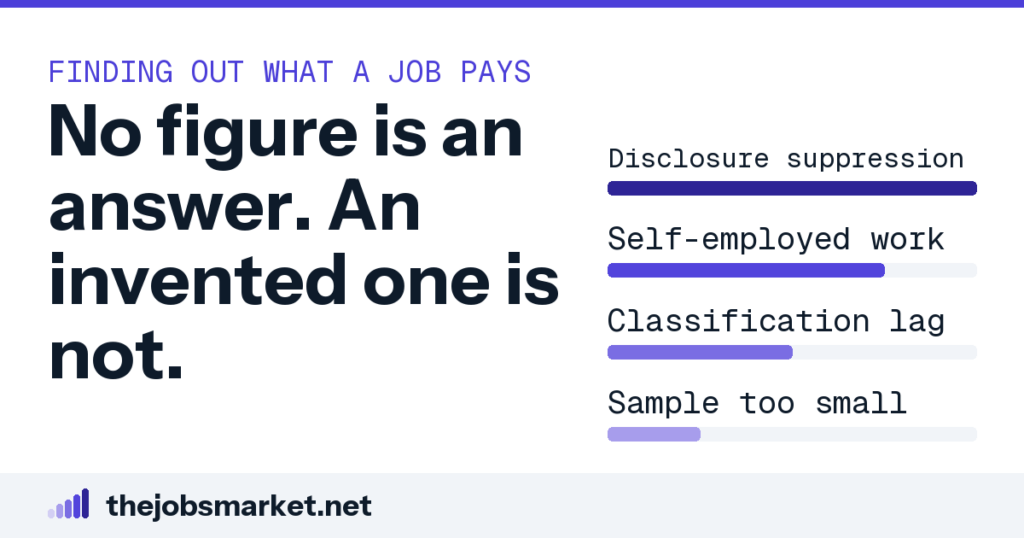
Published wage data has genuine gaps: occupations too small to report without identifying individual employers, work that is predominantly self-employed, roles too new for the classification, and small areas where the sample is too thin. In those cases no figure exists, and the right response is to bracket the answer with adjacent occupations rather than accept an invented one.
Why a figure might be missing
You look up your occupation in your metro and the cell is empty. The instinct is to assume you searched wrong, then to widen until something appears, then to quote whatever turned up. There is a better response, and it starts with understanding why the blank is there. Four different causes produce an empty cell, and they carry quite different meanings.
The most common is disclosure suppression. Where publishing a figure would identify an individual employer, or where the estimate does not meet quality standards, it is withheld deliberately. That is why some occupations show employment but no wage, and why a metro you know has these jobs shows nothing. The rule protects the employers who supply the data, which is what keeps them supplying it.
The second is self-employment. Self-employed people and owners of unincorporated firms are excluded from the survey entirely, because it asks employers what they pay employees. An occupation where most people work for themselves is barely represented, however many people do it. The third is classification lag: genuinely new work only gets a code once it is large enough to count, and until then it sits scattered across adjacent codes.
The fourth is simply looking at too fine a geography. National figures exist for nearly everything, state figures for most things, and metro figures for considerably less. A small occupation in a mid-sized metro is exactly the combination that produces nothing. That is a sampling limit rather than a statement about your work.
A blank is information, not an error
A suppressed metro figure usually means the occupation is small in that area. That answers a question you were very likely also asking, which is whether the place is a market for your work. It answers it in the negative, and that is worth knowing before you plan a move around it. Reading the gap is more useful than skipping past it to find any number at all.
An occupation with no code yet carries a different message. It means employers have no shared vocabulary for the role, which has direct consequences for how you negotiate. There is no agreed benchmark for either side to anchor to, so the conversation will run on something else. Knowing that in advance lets you choose what that something else is going to be.
Widen one step at a time
Go from metro to state to national, and stop at the first level that actually has a figure. Each step trades local accuracy for coverage, and the trade is worth making as long as you know you made it. A national median quoted as though it were local falls apart the moment somebody checks. A national median quoted as a national median remains useful.
Then do the same thing with the occupation itself, moving from the specific code to the broader group it belongs to. A broad group figure is a weak benchmark and it is still a real one. It beats an invented number by a considerable margin, and it comes with a source you can name. Two widening steps usually produce something usable.
Triangulate from adjacent occupations
If your work genuinely sits between two classified occupations, look up both of them. The honest position is that your pay should fall somewhere between the two, weighted by how your week actually splits. That is a defensible argument precisely because it shows your reasoning rather than hiding it. The person opposite can check every step and see that it holds.
Phrase it as the arithmetic it is. This role is roughly two thirds one occupation and one third another, and here are the published medians for both. That is a case somebody can engage with and adjust, which is what you want a negotiation to be. It is far stronger than a single confident number with no method attached.
What to use when nothing official exists
Advertised ranges for roles resembling yours in your metro are the best substitute available. In states with pay transparency requirements they are plentiful, current and specific, and they cost nothing to collect. Gather several rather than one, because any single posting can be unusual. A handful of them is a genuine local benchmark.
Professional association surveys are the second option and they often cover niche occupations no national classification reaches. The samples are smaller and the surveys are designed by people who understand the work, which counts for something. Recruiters who place your specific role are the third, since they see actual accepted offers rather than advertised ones. Their figures are selected and they have an interest, and they are current and specific in a way nothing else is.
Be explicit about the substitution
If you widened from metro to national, say so plainly when you quote the figure. If you used a broader occupational group, say that too rather than hoping nobody asks. A benchmark with its limitations stated is more persuasive than one presented as precise, because the person across the table can check it and finds it honest. That credibility carries over to everything else you say in the conversation.
The opposite approach fails badly and fails fast. Quoting a widened figure as though it were local and specific collapses the moment somebody looks it up. You then spend the rest of the meeting defending your sourcing instead of discussing your pay. The stated limitation costs you nothing and protects the whole argument.
The negotiation this actually calls for
Where no benchmark exists, the conversation shifts from market rate to value delivered. That is harder to prepare for and frequently better for you, because the ceiling stops being what a table says the average is. It becomes what the work is worth to the person paying for it. Plenty of people would prefer that conversation if they realized it was available.
Come with three things rather than a number. What the role actually produces, what it would cost to leave it unfilled for three months, and what comparable responsibility earns in adjacent occupations. None of those requires a figure that does not exist, and all three are checkable in their own way. Together they do the work a median would have done.
Check again next year
Classifications get revised and suppressed cells reappear as occupations grow. Work with no published figure today may well have one within two release cycles, and the first year it appears is a useful moment to revisit your position. Set a reminder rather than trusting yourself to remember. The first published median for an emerging occupation tends to change how everybody in it negotiates.
Until then, the honest answer that no figure exists is a better place to stand than a borrowed one. It tells you which arguments are available and which are not. It also stops you quoting something that will not survive being checked. A missing number is a finding, and an invented one is a liability.
Common questions
Why is there no wage figure for my occupation in my city?
Most often disclosure suppression — too few employers in that area for a figure to be published without effectively revealing what specific ones pay. It can also be a sample too small for a reliable estimate.
What should I use when no figure exists?
Bracket it with the two or three nearest occupations that do have figures. They will not describe your role, but they establish a floor and a ceiling that a single estimate cannot.
Are association salary surveys any good?
Sometimes very good, precisely because they cover roles federal surveys miss. Check the sample size and who responded, and treat them as evidence rather than as a substitute for a national survey.
Why not just publish an estimate?
Because an estimate becomes a citation. Within a couple of years an invented number is being repeated as established, and it is far harder to correct than an absence.
Does self-employed work show up anywhere?
Not in the employer wage survey. Tax filing data and industry surveys are the nearest available and both have worse coverage and comparability. It is a genuine gap.
Why is there no wage data for my job?
Suppression to protect employer identity, an occupation too new to be classified, heavy self-employment which is excluded, or too fine a geography.
What should I use instead?
Advertised ranges in your metro, professional association surveys, and recruiters who place your specific role — each stated as what it is.
Is a blank cell the same as zero?
No. It usually means the occupation is small in that area, which answers a different question you were probably also asking.