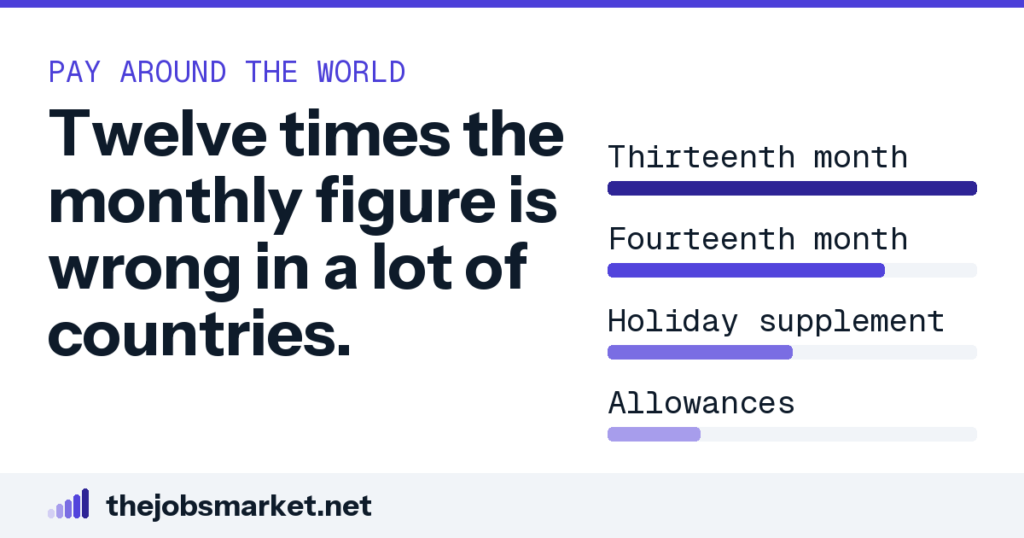
Many countries pay salaries over thirteen or fourteen months rather than twelve, add holiday supplements, apply automatic seniority increments, and pay meal, transport and housing allowances outside the salary line entirely. Multiplying a quoted monthly figure by twelve, which is the instinctive American calculation, can understate the package by fifteen to twenty percent — and the structures are usually contractual rather than discretionary, so they are more reliable than the bonus you are comparing them against.
The mistake happens in the first ten seconds
You are sent a contract with a monthly figure on it. You multiply by twelve, because that is what a year is, and you now have an annual salary you can compare to your own. Somewhere in the next three pages there is a clause explaining that the salary is paid in fourteen installments, and by the time you reach it you have already formed a view about whether the job pays enough. Impressions set in the first ten seconds are surprisingly hard to shift with a footnote on page four, which is why this particular error survives even when the information was in front of you the whole time.
This is the single most consistent error Americans make reading employment contracts from elsewhere, and it runs entirely in one direction: it always undervalues the offer. The structures below are not exotic perks; across large parts of Europe, Latin America and Asia they are the ordinary shape of employment, written into statute or into sector-wide agreements, and often not negotiable in either direction because they apply to everybody.
The thirteenth month, and sometimes the fourteenth
A thirteenth-month payment is an additional month of salary, usually paid at year end. Where a fourteenth exists it typically falls in summer, timed to when people take their holidays. Depending on the country these may be legally mandated, provided by a collective agreement covering the whole sector, or simply so universal in practice that no employer would try to compete without them. The distinction matters more than it sounds, because it tells you whether the payment is a right, a negotiated norm, or a custom that a new owner could decide to stop.
The arithmetic is worth doing explicitly because the proportions are larger than they feel. Thirteen months instead of twelve is an eight percent uplift on the figure you calculated. Fourteen is nearly seventeen percent. On a monthly figure of €4,500, twelve months gives €54,000 and fourteen gives €63,000 — a difference of nine thousand euro that existed the whole time and never appeared in your comparison.
Holiday supplements are a separate thing again
In some countries there is an additional payment specifically tied to taking annual leave, distinct from the extra monthly installments and sometimes calculated as a percentage of salary. The idea is that the holiday itself should cost you nothing, so you are paid your normal wage plus a supplement in the month you take it.
It is easy to conflate this with the fourteenth month because both tend to arrive around the same time of year, and they are not the same item at all. If you are trying to establish what a year actually pays, ask about each by name rather than asking whether there is “extra pay in the summer.” A recruiter answering the vaguer question may honestly tell you about one and not the other, having assumed you meant the one they happened to think of first. Nobody is being evasive; the question simply was not precise enough to get a complete answer.
Seniority increments that arrive without a conversation
In several systems, pay rises automatically with time served, either annually or in bands after a set number of years, under statute or a sector-wide agreement. Nobody negotiates it, nobody asks for it, and it does not depend on a performance rating or on your manager having remembered you in a calibration meeting. It simply arrives, on a schedule that was published before you joined.
For anyone used to a US market where a raise requires a case, a conversation and a manager with budget, this is a materially different proposition. It means the salary you are looking at is a starting position on a ladder rather than a number that will sit still until you fight it upward, and comparing the first rung to a US salary that has no ladder attached understates the difference over any horizon longer than a couple of years. Ask what the increment schedule is and whether it applies to your grade, because the answer changes the ten-year picture far more than the opening figure does.
Allowances that sit outside the salary line
Meal vouchers, transport allowances, and in some countries a housing allowance are paid separately from salary and frequently carry favorable tax treatment. Because they do not appear in the salary figure, they are invisible in exactly the comparison you are making, and their combined value can be a meaningful fraction of monthly pay.
Meal allowances in particular are easy to dismiss as trivial and are not. A daily meal benefit across a working year is a four-figure sum in most currencies, it is typically taxed lightly or not at all, and it replaces spending you would otherwise be doing from taxed income. Transport allowances behave the same way. None of it is glamorous, and the total is often larger than the salary difference somebody is agonizing over.
Notice and severance are part of the pay too
This is the one people leave out entirely, because it is not money you receive while things are going well. In many jurisdictions notice periods run to months rather than weeks, and statutory severance accrues with length of service, so a job quietly carries a value that only materializes if it ends. Nobody enjoys pricing that at the point of accepting an offer. It is still part of what the job pays, and the difference between two weeks and three months is the difference between a scramble and an orderly search.
Set that against at-will employment, where the arrangement can end at short notice with no statutory payment, and the two packages are carrying quite different amounts of risk. It is genuinely difficult to price and it belongs in the decision regardless, particularly if you are moving countries for the role and would have to fund a job search abroad if it went wrong.
The question that catches all of them at once
Rather than asking about each structure individually and hoping you have remembered them all, ask a single broader question: over a full year, what will I actually receive from this employer, including every payment, allowance and benefit, and which parts are guaranteed by contract or law rather than discretionary?
Ask for it in writing. A good employer will produce a straightforward breakdown without any fuss, because in a country where these structures are normal the question is a completely ordinary one and somebody in HR has answered it dozens of times. The answer also tells you something useful about the employer beyond the numbers themselves. An organization that cannot itemize its own package either does not know what it pays or would rather you did not, and both are worth knowing before you sign.
What to do with the number once you have it
Rebuild the annual figure with everything in it, then separate the guaranteed parts from the discretionary ones exactly as you would with a US offer. What frequently emerges is that a foreign package is more certain than the American one it is being compared against — more of it is contractual, less of it depends on a performance rating, and the parts that arrive automatically arrive whether or not anyone remembers to advocate for you.
That certainty is worth something real and it never shows up in a currency conversion. It is also the reason a package that looked smaller in the first ten seconds sometimes turns out, on a proper accounting, to be the better one.
Common questions
What is a thirteenth-month salary?
An additional month of pay, usually at year end. It may be legally mandated, provided by collective agreement, or simply universal in practice — and the distinction tells you how certain the money is.
How much do these structures add?
Thirteen months is an eight percent uplift on a twelve-month calculation; fourteen is nearly seventeen. On a €4,500 monthly figure that is €54,000 against €63,000.
Is a holiday supplement the same as a fourteenth month?
No, though both often arrive in summer. A holiday supplement is tied specifically to taking leave. Ask about each by name, because a vaguer question may get you an answer about only one.
What are seniority increments?
Automatic pay rises with time served, set by statute or sector agreement rather than negotiated. They mean the salary is a starting rung rather than a fixed number.
Are meal and transport allowances worth counting?
Yes. A daily meal benefit across a working year is a four-figure sum, usually taxed lightly, replacing spending you would otherwise fund from taxed income.
Why do notice and severance matter to pay?
Because in many jurisdictions they run to months and accrue with service, which is real value that only materializes if the job ends. Set against at-will employment, the two packages carry different risk.
What is the single question to ask?
Over a full year, what will I actually receive including every payment, allowance and benefit — and which parts are guaranteed by contract or law rather than discretionary? Ask for it in writing.
Which way does this error usually run?
It always undervalues the foreign offer. Multiplying a monthly figure by twelve is the instinctive calculation and it can miss fifteen to twenty percent of the package.