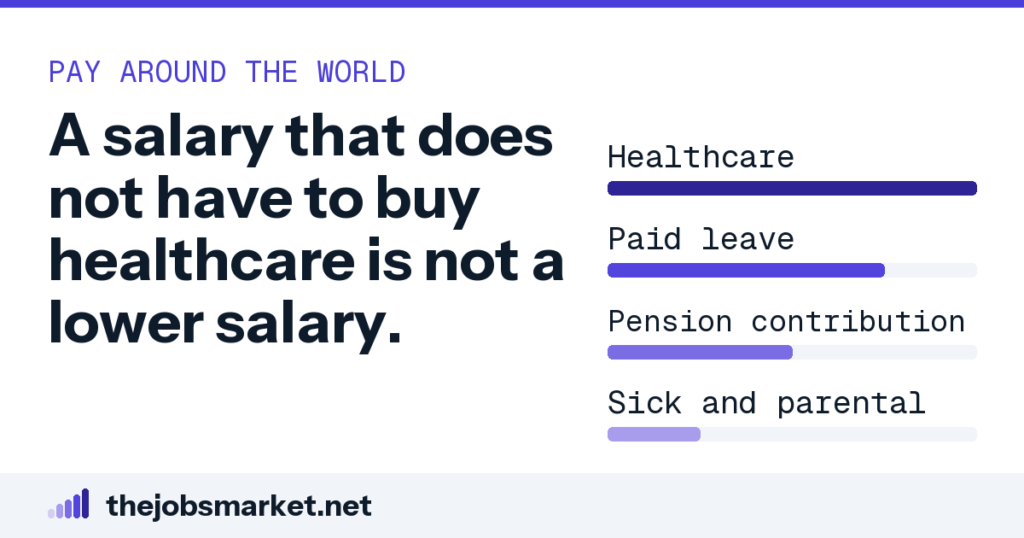
Where healthcare, pension contributions and substantial paid leave are provided by statute, the salary is not expected to fund them, so a gross figure that looks lower can leave you materially better off. The way to compare honestly is to price what each salary still has to buy for your household, then set the two remainders against each other — and to be equally careful in the other direction, because statutory provision varies in quality and does not cover everything.
Two offers, and the one that looks worse
An American earning $105,000 is offered a role in a European capital at the equivalent of $82,000. The conversion is straightforward, the gap is twenty-three thousand dollars, and the natural conclusion is that this would be a significant step down. It is a reasonable first reading and it leaves out the entire second half of the arithmetic. The question is not which salary is larger; it is which salary is larger once each has paid for the things the other does not have to.
That sounds like special pleading for the lower number, and it frequently cuts the other way too. The point is that the comparison has two halves and almost everybody stops after the first. Doing the second half takes an evening and occasionally reverses the answer entirely, which makes it a good use of an evening.
The four that move the most money
Healthcare is the largest by a distance for anyone with a family. In a system funded through general taxation or payroll contributions, premiums are not something you budget for, and the deductibles and out-of-pocket maximums that shape an American household budget largely do not exist in the same form. For a family accustomed to funding coverage privately, this single line can account for most of a nominal salary gap on its own.
Pension provision is the second. Where contributions are mandatory and partly employer-borne, retirement saving that you would otherwise be doing voluntarily from take-home pay is happening automatically before you see the money. Paid leave is the third — statutory minimums of four to six weeks are common, alongside public holidays, and where a holiday supplement exists you are effectively paid extra for taking it. And parental leave is the fourth, running to months rather than weeks in many systems and frequently paid at a meaningful proportion of salary.
How to put a number on each
Use what you actually pay now rather than a national average, because the average household is not you. For healthcare, take your current annual premium contribution plus a realistic figure for out-of-pocket spending in a normal year. For retirement, take what you currently contribute voluntarily, on the reasoning that a mandatory scheme abroad is doing the same job. For leave, value the days above your current entitlement at your daily rate.
Parental leave is the hardest to price and the most consequential if it applies to you. Rather than trying to assign an annual value, work out what the difference would actually be worth once, for the number of children you expect to have, and treat it as a lump sum in the decision. It is not a recurring line item and pretending it is will distort the rest of the arithmetic.
The mistake in both directions
The first mistake is the obvious one: comparing gross salaries, concluding the foreign offer is worse, and never subtracting what you would stop paying for. That error has a consistent direction and it is the reason plenty of people decline offers that would have left them better off.
The second mistake runs the other way and is less discussed. Statutory provision is not uniformly excellent, and assuming it is can be an expensive romance. Waiting times, the scope of what is covered, whether a supplementary private policy is the norm among people at your income level, and how good the state pension actually is at replacing income all vary enormously between countries with similar-looking headline arrangements. Ask people who live there rather than reading a comparison of systems, because the lived answer and the structural answer are not always the same.
What statutory benefits do not do
They do not make a genuinely low salary acceptable. If a role pays badly for the local market, no amount of public healthcare fixes that, and the local percentile range for your occupation is still the first thing to check. Statutory provision changes the conversion between two countries; it does not change where you sit inside one.
They also do not travel with you. If you leave after three years, the pension contributions may or may not be portable, the healthcare entitlement stops at the border, and the parental leave you never used has no residual value. For anyone treating a move as temporary, the benefits are worth considerably less than their headline value, and that is a legitimate reason to weigh them lower.
A worked version of the two offers
Return to the $105,000 against $82,000. Suppose the American household currently pays $9,000 a year in premium contributions and another $4,000 in out-of-pocket costs, contributes $6,000 voluntarily to retirement, and pays $14,000 for childcare that would be substantially subsidized in the destination.
That is $33,000 a year of spending the second salary does not have to cover. Set against a nominal gap of $23,000, the lower offer comes out ahead by roughly ten thousand dollars a year before any adjustment for local prices at all. Change the household — a single person with no children and no health costs — and the same two offers reverse, decisively. Both results are correct, and which one applies is a fact about you rather than about the countries.
The one nobody counts, and probably should
Sick pay is the benefit that never makes it into anyone’s spreadsheet, right up until the year it matters more than everything else on the list. In many countries a period of illness is paid at a substantial proportion of salary for months, by statute, with the job protected throughout. In an at-will arrangement with a limited allowance of paid days, a serious illness is a financial event as well as a medical one.
It is genuinely difficult to price, because the expected value in any given year is small and the value in a bad year is enormous. That does not make it worth zero, which is the number it gets assigned by default. If you have any reason to think the risk applies to you more than averagely, it deserves a line of its own rather than a shrug.
The comparison worth making
Two columns, your own figures, and a line at the bottom of each for what remains after the salary has paid for everything it must. Compare the remainders rather than the salaries, and then, only then, adjust for what money buys locally.
What you get from doing it properly is not just a better answer but a durable one. You will know which assumption the result is resting on, and if your circumstances change — a child, a health issue, a plan to return home in four years — you will know immediately which way the answer moves.
Common questions
Which statutory benefits matter most?
Healthcare, mandatory pension contributions, statutory paid leave of four to six weeks, and parental leave running to months. Healthcare is the largest by a distance for anyone with a family.
How do I price them?
Use what you actually pay now, not a national average. Current premium plus realistic out-of-pocket spending, current voluntary retirement contributions, and leave days above your entitlement at your daily rate.
How should I handle parental leave?
As a one-off rather than an annual line. Work out what the difference would be worth once, for the number of children you expect, and treat it as a lump sum in the decision.
What is the mistake people make?
Comparing gross salaries and never subtracting what they would stop paying for. It has a consistent direction and causes people to decline offers that would have left them better off.
Is there a mistake in the other direction?
Yes. Statutory provision is not uniformly excellent. Waiting times, scope of coverage, whether private top-up is the norm, and how well the state pension replaces income all vary. Ask people who live there.
Can good benefits make up for low pay?
No. If a role pays badly for the local market, public healthcare does not fix it. Check the local percentile range for your occupation first — benefits change the cross-border conversion, not your position within a country.
What if I only plan to stay a few years?
Weigh them lower. Pension contributions may not be portable, healthcare entitlement stops at the border, and unused parental leave has no residual value.
Can you show the arithmetic?
On $105,000 against $82,000, a household paying $13,000 in health costs, $6,000 in voluntary retirement and $14,000 in childcare has $33,000 the second salary need not cover — so the lower offer wins by about $10,000.