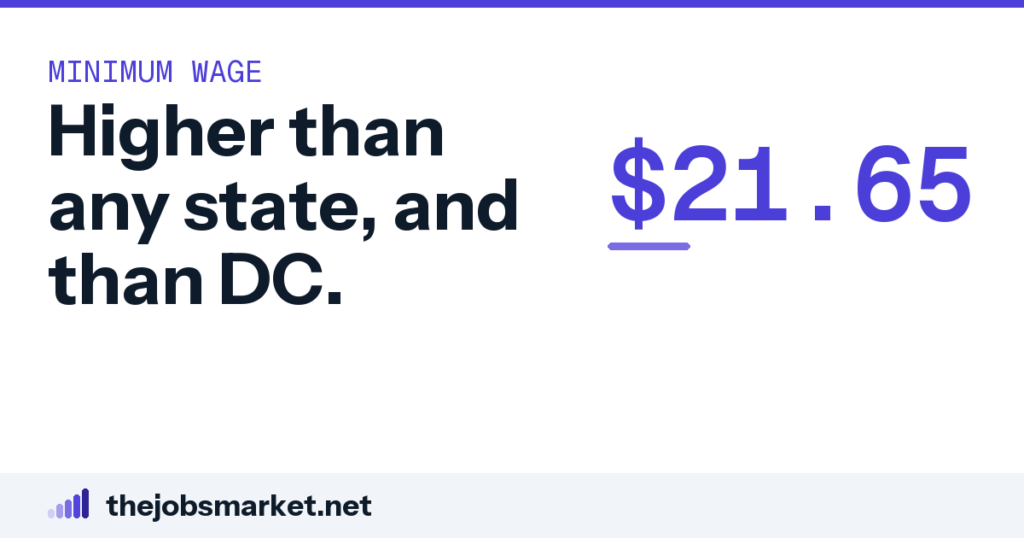
Tukwila, Washington runs a minimum wage of $21.65 in 2026 — the highest of any jurisdiction in the United States, above every state and above the District of Columbia. Local ordinances like it exist because cities face housing costs their state legislature does not have to answer for, and because a state figure set for the whole state is necessarily set for its cheapest parts. Roughly half the states block cities from doing this at all through preemption laws.
The highest floor in the country is municipal
Tukwila is a small city in King County, Washington, sitting next to Seattle-Tacoma airport with a population somewhere around twenty-one thousand. Its minimum wage in 2026 is $21.65 an hour. That is the highest of any jurisdiction in the United States — higher than Washington’s own state rate, higher than every other state, and higher than the District of Columbia. A city most people outside the region have never heard of sets the country’s top wage floor.
That fact is worth sitting with for a moment, because it inverts the assumption most people carry about how wage floors work. The instinct is that states set rates and cities follow. In a substantial part of the country the local layer is the one that binds, and a national article quoting your state’s figure may be describing a number nobody in your city is actually paid.
It also explains why “what is the minimum wage” is a harder question than it sounds. The honest answer for a great many people is a city or county figure they have never looked up. Nothing in ordinary life prompts anybody to check the third layer, and employers with a single location rarely mention which layer their rate came from. The number on the payslip arrives without a citation.
Why cities do this
The straightforward reason is that housing costs vary enormously inside a single state, while a state rate has to be set for the whole of it at once. A figure that works in a rural county is a very different proposition in the metropolitan area two hours away. The legislature setting it answers to both places, which pulls the number toward the middle and leaves the expensive end unserved. That gap is the space local ordinances fill.
Cities also face the consequences directly in a way a state government does not. A municipality watching essential workers priced out of the city they serve has a specific local problem, and a wage floor is one of the few tools a city actually controls. That is why the ordinances cluster in expensive metropolitan areas rather than being distributed evenly.
The Tukwila case is instructive on this point. It was passed by ballot initiative rather than by council, in a small city with a large concentration of airport and hospitality employment, and the initiative route matters — several of the highest local rates in the country arrived the same way. Where a legislature is reluctant, a ballot measure is the mechanism that has repeatedly worked.
Preemption cuts the other way, and it covers half the country
Roughly half the states have passed preemption laws prohibiting cities and counties from setting their own minimum wage. In those states a local ordinance is not merely uncommon; it is unlawful. Several have been passed by a city council and then struck down, occasionally after being in force long enough for employers to have adjusted to them. Preemption is the quiet half of this subject and it shapes the map more than anything else.
This is the single biggest reason the map looks the way it does. Local minimum wages are not concentrated in expensive metros because only expensive metros want them; they are concentrated there partly because those metros are in states that permit it. A high-cost city in a preemption state has no route to a local rate however strongly its residents feel.
Preemption has also operated retroactively in some cases, invalidating ordinances that were already in force. That has produced genuine confusion for employers and workers alike in a handful of places, with people paid one rate for a period and a different one afterwards. If you are looking at a local ordinance, check that it is currently in effect rather than merely on the books — the municipality’s own page will say, and a third-party summary frequently will not.
The compliance trap
The practical failure this creates is geographic rather than legal. An employer with locations on both sides of a city line owes different rates in each, and an employee who works shifts at two branches can be owed two different rates in the same week. Payroll systems configured at the company level rather than the site level get this wrong routinely.
Remote and mobile work makes it harder again. A delivery driver, a home care worker or a field technician can cross a boundary several times a day, and the usual approach is to apply the rate for the hours worked in each jurisdiction. That requires a timekeeping system with a field for location, and a great many do not have one.
Working from home is the version that catches office employers. If an employee lives inside a city with an ordinance and works from their kitchen table, that ordinance can apply to them even though the employer has no premises there and has never heard of the city. Small employers hiring their first remote worker are frequently unaware this is even possible.
A worked example of the gap
Take somebody working full time at the federal floor of $7.25 against somebody at the Tukwila rate of $21.65. That is 2.99 times as much per hour. Across a 2,080-hour year the difference is $15,080 against $45,032 — a gap of just under $30,000 for the same hours of work.
Neither figure describes a typical worker, and the point is not that the comparison is a fair one to make. The point is that “the minimum wage” is not one thing at all. The range between the lowest and highest applicable floors in this country is wider than the entire annual salary of somebody standing on the lowest one, which is a fact about the structure rather than about anybody’s politics.
What to check for your own job
Search your city and county by name alongside the phrase minimum wage ordinance, and read the municipality’s own page rather than a summary of it. Check three things in order: whether the ordinance exists, whether it is currently in force, and what its coverage threshold is. Many apply only to employers above a certain size, and several set different rates for large and small employers within the same ordinance. A rate that does not reach your employer is not your rate.
Then check whether the ordinance is indexed. Most local rates rise annually with a price index on a fixed date, which means the figure you find in an article written last year is almost certainly wrong now. The municipality publishes the current one.
Why this keeps moving
Around eighty-eight jurisdictions changed a minimum wage rate during 2026 across the state and local layers combined. That is the practical reason any article on this subject has a short shelf life, this one included. It is also why the useful habit is checking the source rather than remembering a number — a figure you memorized is a figure that will quietly go wrong on you at some point in the next twelve months.
The direction over the past decade has been steadily upward at state and local level while the federal floor has not moved since 2009. Whether that continues is a political question rather than a forecast anybody can responsibly make from the data. The structural point holds either way: as long as the federal figure sits still, the action stays local. And the local layer is the one you have to look up, because it is the one nobody will tell you about.
This is general information about how local ordinances work rather than legal advice about your pay. Rates, coverage thresholds and preemption rules all change frequently — your city or state labor office has the current position and will answer a question without any obligation to file anything.
Common questions
What is the highest minimum wage in the US?
Tukwila, Washington at $21.65 in 2026 — higher than any state and higher than the District of Columbia. It was passed by ballot initiative in a city of about 21,000 people.
Why do cities set their own rates?
Because housing costs vary enormously inside a state and a state rate has to be set for the whole of it, including its cheapest parts. A wage floor is one of the few tools a city actually controls.
Can every city do this?
No. Roughly half the states have preemption laws prohibiting local minimum wages, so an ordinance there is unlawful rather than merely unusual — several have been passed and struck down.
What if I work at two branches?
You can be owed two different rates in the same week. The usual approach is to apply the rate for the hours worked in each jurisdiction, which requires a timekeeping system with a location field.
Does a city ordinance apply if I work from home?
It can. If you live inside a city with an ordinance and work from there, it may apply even though your employer has no premises in that city and has never heard of it.
How big is the range?
$7.25 against $21.65 is 2.99 times. Over a 2,080-hour year that is $15,080 against $45,032 — a gap of just under $30,000 for the same hours.
What should I check?
Whether an ordinance exists, whether it is currently in force, its coverage threshold — many apply only above a certain employer size — and whether it is indexed to rise annually.
Why does this change so often?
Around eighty-eight jurisdictions changed a rate during 2026. Most local rates are indexed and rise on a fixed date, so any figure quoted in an article has a short shelf life.