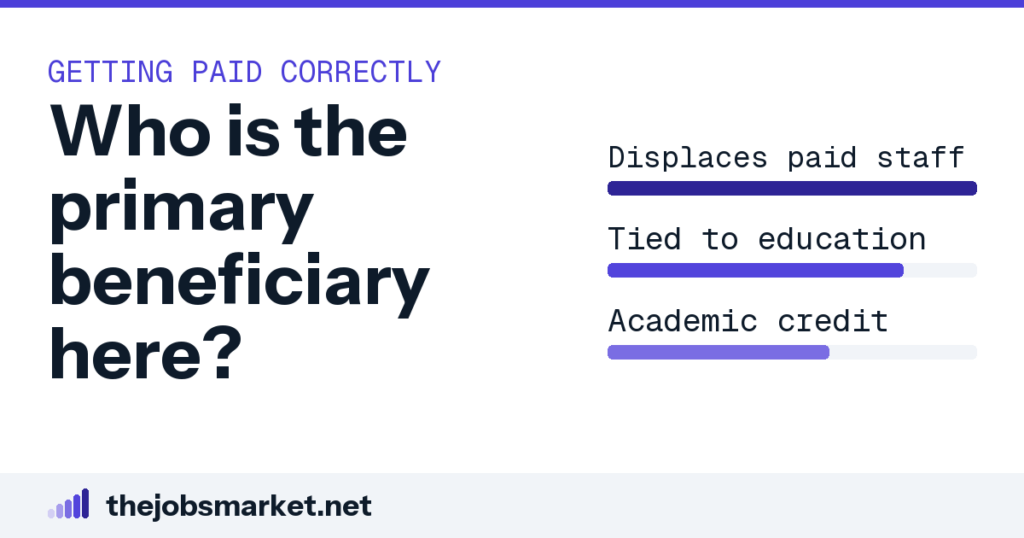
An unpaid internship is lawful only where the intern is the primary beneficiary of the arrangement. That is assessed against seven non-exhaustive factors weighed together rather than a checklist, and no single one is decisive — including academic credit, which helps but settles nothing. In practice the question that does most of the work is displacement: an intern performing work the employer would otherwise have paid somebody to do is an employee, and is owed wages.
The primary beneficiary test
The framework asks a single question in several parts: between the intern and the employer, who is the primary beneficiary of this arrangement? If the answer is the intern, the internship can be unpaid. If it is the employer, the intern is an employee and minimum wage and overtime apply.
Seven distinct factors inform that judgment together. Whether both parties understand there is no expectation of pay. Whether the training is similar to what would be given in an educational environment. Whether it is tied to a formal education program or academic credit. Whether the schedule accommodates the intern’s own academic calendar. Whether its duration is limited to the period of beneficial learning. Whether the intern’s work complements rather than displaces paid employees. And whether both understand there is no entitlement to a job at the end.
The crucial feature is that these are weighed together and no single factor decides. That flexibility cuts both ways: an employer cannot secure lawfulness by ticking one box, and an intern cannot establish a violation by pointing at one failing. The overall picture is what governs the answer.
Displacement does most of the work
Among the seven, the displacement question is where most arrangements actually resolve, because it is the most observable of the seven and the hardest to characterize away in either direction. An employer can argue about most of the seven factors and struggles to argue about whether a desk needed staffing. Rotas, schedules and task assignments all exist in writing somewhere.
The test is straightforward to apply to your own situation. If you had not been there, would the employer have needed to pay somebody to do what you did? An intern shadowing, observing, attending meetings and working on projects designed for their learning is not displacing anybody. An intern covering a rota, staffing a desk, handling a client queue or producing deliverables on the same terms as paid staff is.
That framing explains why internships in busy operational environments are so frequently unlawful while ones in structured programs are not. It is rarely about intent — an employer short-staffed in July genuinely needs the help, and needing the help is precisely what makes the intern an employee. The employer’s need for the help is itself the evidence.
Academic credit helps and does not settle it
The most persistent misunderstanding in this area is that academic credit makes an unpaid internship lawful. It does not do so on its own. Credit is one factor among seven, it weighs in the employer’s favor, and it is routinely present in arrangements that fail the overall test.
The reason it does not settle anything is that credit describes the intern’s relationship with their institution rather than the nature of the work performed. A student can be receiving credit while spending forty hours a week doing exactly what a paid employee would do, and the credit does nothing whatever to change who benefited from the arrangement. Credit is between you and your institution; the work was between you and the employer.
Employers frequently believe otherwise and say so in good faith, because the belief is widespread and rarely challenged. It is worth knowing that the confident answer you may receive on this point is not the legal position, however sincerely it is offered. It is usually offered sincerely, by somebody repeating what they were told when the program was set up.
Non-profits and the public sector
The analysis differs outside the private sector and the difference is real. Individuals who volunteer their time for public service, religious or humanitarian objectives at non-profit organizations, without expectation of compensation, are generally not employees — genuine volunteering is a recognized category rather than a loophole somebody found. It exists because volunteering is a real thing people do.
The distinction turns on whether the arrangement is genuinely volunteering or is an unpaid job in a non-profit setting. Someone volunteering a few hours a week for a cause is different from someone working full-time in a role the organization would otherwise fill with a paid employee, and the second arrangement is not made lawful by the employer’s charitable status. The mission does not change who was doing the work.
Public sector internships also sit under different rules in several respects. If you are in either setting, the private-sector analysis above is a poor guide and the specific rules are worth checking directly rather than reasoning across from the private sector. The analysis genuinely differs, and applying the wrong framework produces a confident wrong answer.
State law can be stricter
Several states apply their own tests, and some are more demanding than the federal primary beneficiary framework — a few retain versions of an older, more rigid test under which failing any single element defeats the arrangement outright, with no weighing at all. That is a considerably harder standard for an employer to meet, and it is why the state question matters here.
Where a state test is stricter, it governs, in line with the general rule that the more protective standard applies. So an internship that survives federal analysis can still be unlawful under state law, which is another reason the state question comes before the federal one here as it does everywhere else in this section. It takes about two minutes to settle on your state labor department’s own pages.
What it is worth
Work out the figure before deciding whether to pursue anything, because it is usually larger than it feels. A ten-week internship at forty hours a week is 400 hours. At a $15.00 minimum that is $6,000, and at a higher state or city minimum it is more — plus overtime for any week above forty.
That number matters for a second reason as well. Wage claims carry limitation periods, commonly two years and three where a violation is willful, so an internship from four summers ago is likely beyond reach while last summer’s is not. If you are going to look into it, the time to do so is now rather than after graduation.
If you think you should have been paid
Write down what you actually did, week by week, with particular attention to whether it duplicated the work of paid staff. Keep any schedule, rota or task assignment you still have access to. That record is the displacement evidence and it is the strongest thing you can hold.
Then raise it or file it. A wage claim through the state labor agency is free, requires no lawyer, and can be brought after the internship has ended by somebody who is no longer connected to the organization. Many people assume the arrangement is closed once they leave, and it is not.
This is general information about how the test works rather than legal advice about your situation. The weighing of seven factors is genuinely fact-specific and state rules differ, so your state labor agency or an employment lawyer is the place to test your own facts — and they will discuss it without any obligation to file.
Common questions
When is an unpaid internship lawful?
When the intern is the primary beneficiary of the arrangement, assessed against seven non-exhaustive factors weighed together. No single factor decides it.
Does academic credit make it lawful?
No. Credit is one factor among seven and weighs in the employer's favor, but it describes your relationship with your institution rather than the nature of the work performed.
Which factor matters most in practice?
Displacement. If the employer would have had to pay somebody to do what you did, you are an employee — that question is the most observable and the hardest to characterize away.
How do I apply the displacement test?
Ask whether the employer would have needed to hire someone if you had not been there. Shadowing and learning projects do not displace anybody; covering a rota or handling a client queue does.
Is it different at a non-profit?
Yes. Genuine volunteering for public service, religious or humanitarian objectives is a recognized category — but an unpaid full-time role a non-profit would otherwise fill with paid staff is not made lawful by charitable status.
Can state law be stricter?
Yes, and where it is, it governs. A few states retain older, more rigid tests under which failing any single element defeats the arrangement.
How much could be owed?
A ten-week, forty-hour internship is 400 hours — $6,000 at a $15.00 minimum, more against a higher state or city rate, plus overtime for any week above forty.
Can I claim after it ended?
Yes. A state wage claim is free, needs no lawyer, and can be brought by somebody no longer connected to the organization — but limitation periods run, commonly two years and three if willful.