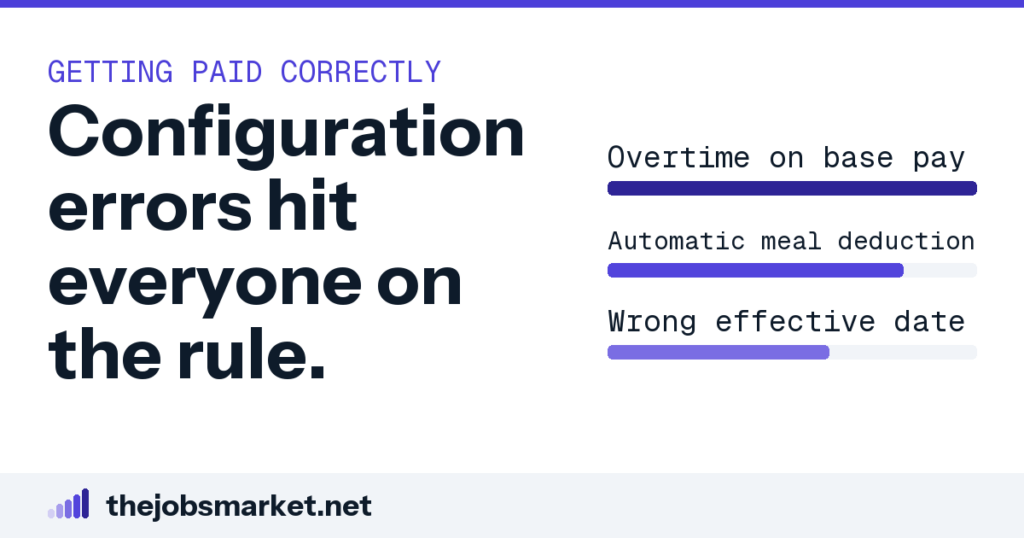
Most payroll shortfalls are errors rather than decisions, and three account for the majority: overtime calculated on the base wage instead of the regular rate, automatic meal deductions applied whether or not a break was taken, and rate changes applied from the wrong effective date. Each is small on any single stub and substantial across a year, which is exactly why they survive — and why raising one usually corrects it for everybody on the same configuration.
Overtime on the wrong base
This is the costliest of the common errors and the least visible. Overtime is owed at one and a half times your regular rate, which is a weekly calculation: everything you earned that counts, divided by the hours you actually worked. It includes shift differentials, nondiscretionary bonuses and commissions, not just your base hourly wage.
A payroll system configured to multiply the base wage by 1.5 produces a plausible number that is too low for anybody earning anything beyond straight hourly pay. On a $20 base with a $3 differential on twenty hours and a $150 production bonus, the regular rate for a forty-five hour week is $24.67, so the premium owed is $61.65 rather than the $50 the base calculation gives — a difference of $11.67 for that week alone, or a little over $600 across a year of similar weeks.
Eleven dollars and change a week is invisible on a stub and roughly $600 a year, and across a crew of thirty it is a number somebody would have to explain. The error persists because every individual instance is too small to notice. It is also too tedious to check against a formula nobody has ever explained to you, which is the other half of why it survives.
Automatic meal deductions
The second is more provable than the first and easier to raise. Many timekeeping systems deduct thirty minutes per shift automatically, on the assumption a break was taken. In a quiet week that assumption is accurate; in a busy operation it frequently is not.
What makes this one worth pursuing is that the evidence usually exists independently. Till transactions, system logins, message timestamps, badge records — a system that shows you working continuously through a period that was deducted is a straightforward contradiction, and it does not depend on anybody’s recollection of a shift months ago. Recollection is the thing that sinks most informal complaints, and this error does not need any.
The deduction is not unlawful in itself, provided there is a reliable mechanism to correct it and people actually use it. The question worth asking is what that mechanism is and whether anybody has ever successfully used it. A correction process that exists on paper and irritates a manager in practice is not a mechanism.
Effective dates
The third is the most common and the easiest to check. When a raise, promotion, or benefit change takes effect mid-period, the calculation has to split the pay period, and split-period arithmetic is where payroll systems most reliably produce a wrong answer that looks entirely right on the page. The figure is plausible, the arithmetic is internally consistent, and it matches nothing anybody is entitled to.
The error usually shows up as a raise applied from the start of the next full period rather than from the date it was granted, quietly costing you the intervening days. Sometimes it is the reverse and favors you, which is worth noticing too, both because it is honest and because it tells you the direction is random rather than systematic. That is a useful thing to establish before deciding how to raise it, because a random error is a bug and a one-directional one is something else.
The check is simple: any stub covering a change deserves more attention than an ordinary one. Compare the effective date on the letter to the pay period dates on the stub and confirm the split was made where it should have been. Two dates and one comparison.
The others worth checking
A handful of others recur often enough to be worth a look. Commission timing, where a payment lands in a period after the one it was earned in and the overtime for the earlier weeks is never recalculated. Retroactive adjustments applied without any explanatory line, so the total moves and nothing says why.
Benefit elections processed a period late, so a premium comes out twice or not at all. Rounding practices that are not neutral over time, favoring the employer at both ends of a shift. And paid time off deducted at the wrong rate for somebody whose pay varies.
Why these survive so long
It is worth understanding why payroll errors persist for years in organizations that are otherwise well run, because the answer tells you how to raise one. Nobody checks. Employees glance at the net figure, confirm it is roughly what they expected, and file the stub. Payroll processes what the system produces and reconciles totals rather than recalculating individual entitlements.
The configuration itself was usually set up once, at implementation, by somebody working from an assumption about how the business operated. That person has frequently left, the assumption is no longer documented anywhere, and nothing in the annual cycle prompts a review of whether the overtime formula still matches the law or the shift patterns still match the deduction rules configured around them. Shift patterns change and configurations rarely follow.
So the practical situation is that a small recurring error has no natural discoverer. Auditors check that the money paid matches the money recorded, which it does. The only person positioned to notice is the individual whose pay is short, and the amount is deliberately small enough that noticing takes effort. That is not a conspiracy; it is what a system without a specific check looks like from the inside.
Why raising one helps more than yourself
This is the part worth understanding before deciding whether it is worth the awkwardness. Payroll errors are configuration errors, and a configuration applies to everybody it covers. An overtime formula set up wrongly is wrong for every non-exempt employee at that employer; an automatic meal deduction runs on every shift in the system.
So the person who raises it is rarely the only person affected, and the correction rarely applies only to them. Employers who discover a systematic error usually have to correct it across the group, because the alternative is a much larger exposure with a limitation period attached to every week of it. The clock runs backwards from today, so the exposure shrinks while nobody acts.
That also changes how the conversation goes. An employer hearing about a formula problem is hearing about their own liability, not just about your paycheck, and a well-advised employer would much rather know now. The alternative is finding out when somebody leaves and files a claim covering everybody on the same configuration.
How to raise it
Be specific about a period rather than general about a feeling. “The overtime on the period ending the 14th — how was the regular rate calculated?” points somebody at a calculation they can rerun in a minute. “My pay looks low” invites a conversation about how you feel about your pay.
Check three periods before raising anything, because a single stub can look wrong for timing reasons that resolve on the next one. A pattern across three is a question; one period on its own is often just an artifact of timing. A retroactive adjustment or a late benefit election produces exactly the same appearance.
Send it in writing, keep a copy outside company systems, and work out the annual figure before you send it. A $12 weekly shortfall is $624 a year, and the annual number is what makes it obvious to everybody that this is worth ten minutes of somebody’s attention. Presented as a weekly figure it invites a shrug and a filed stub; presented annually it does not.
This is general information about where payroll errors concentrate rather than legal advice about your pay. If a shortfall has run for a long time or the employer will not correct it, your state labor agency can tell you what is recoverable — and they will answer without any obligation to file a claim.
Common questions
What is the costliest common payroll error?
Overtime calculated on the base wage rather than the regular rate, which includes shift differentials, nondiscretionary bonuses and commissions divided across hours actually worked.
Can you show the difference?
On a $20 base with a $3 differential on twenty hours and a $150 bonus across forty-five hours, the regular rate is $24.67 — so the premium owed is $61.65 against $50 from the base calculation.
Why are automatic meal deductions worth pursuing?
Because the contradicting evidence usually exists independently — till transactions, logins, message timestamps or badge records showing you worked through a deducted period.
Are automatic deductions unlawful?
Not in themselves, provided a reliable correction mechanism exists and people actually use it. A process that exists on paper and irritates a manager in practice is not a mechanism.
What goes wrong with effective dates?
Split-period arithmetic. A raise is often applied from the next full period rather than the date it was granted, costing the intervening days. Any stub covering a change deserves a closer look.
What else recurs?
Commission paid in a later period without recalculating earlier overtime, unexplained retroactive adjustments, late benefit elections, non-neutral rounding, and paid time off valued at the wrong rate.
Does raising it help anyone else?
Usually. Payroll errors are configuration errors, so a wrong formula is wrong for everybody it covers — and employers generally have to correct it across the group.
How should I raise it?
Name a specific period and ask how the calculation was made. Check three periods first, send it in writing, and work out the annual figure — $12 a week is $624 a year.