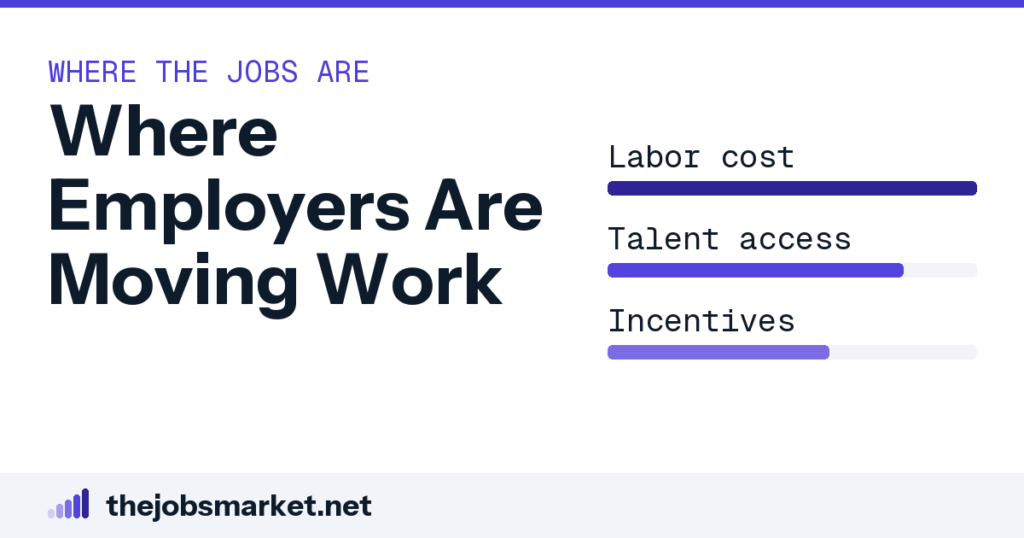
No published series tracks work relocation directly. What can be observed is the resulting distribution, and the recurring drivers are labor cost, talent availability, tax and incentive packages, and proximity to customers or infrastructure. Announcements consistently overstate both the size and the speed of moves, because the announcement is made at the point of maximum intention and minimum commitment.
Four reasons work moves, and only one gets announced
Relocation announcements are publicity. What actually moves shows up years later in the employment data, and it moves for four distinct reasons. Only one of the four ever reaches a press release.
Labor cost is the first: the same occupation at a materially lower median somewhere else. That drives back-office, support and shared-service functions more than anything else, and it is the motive least likely to be stated out loud. Nobody ever announces that they have found somewhere cheaper.
Talent availability is the opposite motive and it moves work toward expensive places rather than away from them. A function that cannot hire enough people goes where the people are, which is why specialist teams end up in metros with the highest costs. Tax and incentives come third and are usually smaller than the headline, while proximity to customers, freight, a research cluster or a regulator is slower-moving and more durable when it happens.
Why announcements mislead
A relocation is announced when it is decided and reported as though it has already happened. Those are separated by years rather than months. The gap between deciding and moving is where the error lives.
The headcount quoted is almost always a multi-year target, frequently contingent on conditions being met. It gets revised quietly when it is revised at all, and the revision never gets the coverage the announcement did. The original figure stays in circulation for years regardless.
Meanwhile the roles that move first are the easiest to move, which are rarely the ones described in the press release. An announcement about a thousand engineering jobs frequently begins with sixty people in finance and procurement. The engineering half may never arrive at all.
What to watch instead
Watch an employer’s job postings by metro over time. That shows where they are actually hiring rather than where they said they would, and all of it is public. Postings are the closest thing to a live feed available.
Watch for a few months rather than a few weeks, because hiring patterns are noisy over any short window. A single month tells you very little and a quarter tells you a great deal. Patience is most of the method in this particular check.
Then watch a metro’s occupational concentration across successive data releases. If a cluster is genuinely forming that figure rises steadily, and if it is not, the announcement was the entire event. Concentration is slow to move and hard to fake.
Which functions move and which stay
Work whose output is standardized and verifiable moves readily. Transactions, processing, first-line support and anything measured by throughput and checked against a rule. If a checklist can verify it, distance stops mattering.
Work requiring judgment, relationships or physical presence moves least. So does anything where somebody must be personally accountable to a regulator in a particular jurisdiction. Personal accountability is genuinely difficult to relocate anywhere.
That is the same distinction governing which tasks automate, and for the same underlying reason. Both are asking whether the work can be specified precisely enough to hand to somebody who is not in the room. Specification is the property that decides both questions.
What it means for you specifically
If your function is the kind that moves, the question is whether you sit in the origin or the destination. Those are different positions with different trajectories. Neither one is safe or unsafe on its own.
The destination is cheaper for the employer, which has implications for your pay trajectory even when your role is perfectly safe. Cheaper is why the work arrived and it does not stop being true once you are hired. The cost logic continues operating in the background.
Being in the origin is not automatically bad either. Origin sites usually retain the judgment-heavy work and shed the process-heavy work, so what matters is which half of your own job is which, and that is worth knowing before anybody announces anything. An honest audit of your own week answers it quickly.
Checking your own exposure
Compare your metro’s median for your occupation against the national figure for the same occupation. That takes two lookups and about a minute. Both figures are published and free to anybody.
A large premium is exactly the condition that makes a finance director look at a map. It is published for anybody to see, including them, and they are looking at the same table you are. The data is not a secret in either direction.
Then ask honestly what proportion of your week is standardized and verifiable. High premium plus high proportion is the combination worth acting on, and acting on it usually means moving toward the judgment work rather than moving house. That move is available inside your current role.
Remote work changed the shape of this
Moving work used to mean moving a building, which is slow, visible and expensive enough that it only happened for large functions. That visibility gave everybody involved plenty of warning. A building takes years to plan and months to fill.
Distributed hiring lets an employer relocate a function one vacancy at a time without announcing anything at all. There is no building, no press release and no moment anybody could point at. The change is real and it has no announcement date.
That is the version most people will actually experience. Nobody says the team is moving; the next three hires are simply made somewhere cheaper, and two years later the center of gravity has shifted entirely. By then the origin site has become the smaller one.
The pay question this creates
An employer hiring across locations has to decide whether to price a role by the company’s market or by the worker’s. Both policies are common and both are defensible. Neither one is a sign of a badly run employer.
They produce very different numbers for identical work, sometimes differing by a third or more. Nothing about the job description reveals which one is in operation. You have to ask, and the answer is readily given.
Ask which applies before accepting a distributed role, and ask separately what happens if you move. A policy that adjusts pay downward on relocation is a materially different job from one that does not, and it is a normal question any well-run employer will answer plainly. Reluctance to answer is informative in its own right.
Common questions
Is work relocation tracked in official data?
Not directly. Only the resulting distribution is observable, through occupational employment by metro across successive releases.
Why do employers move work?
Labor cost, talent availability, tax and incentive packages, and proximity to customers, freight or research clusters.
Why do announcements mislead?
They are made when a decision is taken, cite multi-year contingent targets, and are revised quietly afterwards.
What should I watch instead?
An employer's postings by metro over time, and whether a metro's concentration in your occupation actually rises across releases.
Which functions move most?
Those whose output is standardized and verifiable. Judgment, relationships and physical presence move least.
Why do employers relocate work?
Labor cost, talent availability, tax incentives, and proximity to customers, freight, research or regulators. The first is the least likely to be stated publicly.
Are relocation announcements reliable?
They are decisions reported as events. The headcount is usually a multi-year contingent target, and the roles that move first are the easiest ones rather than the ones described.