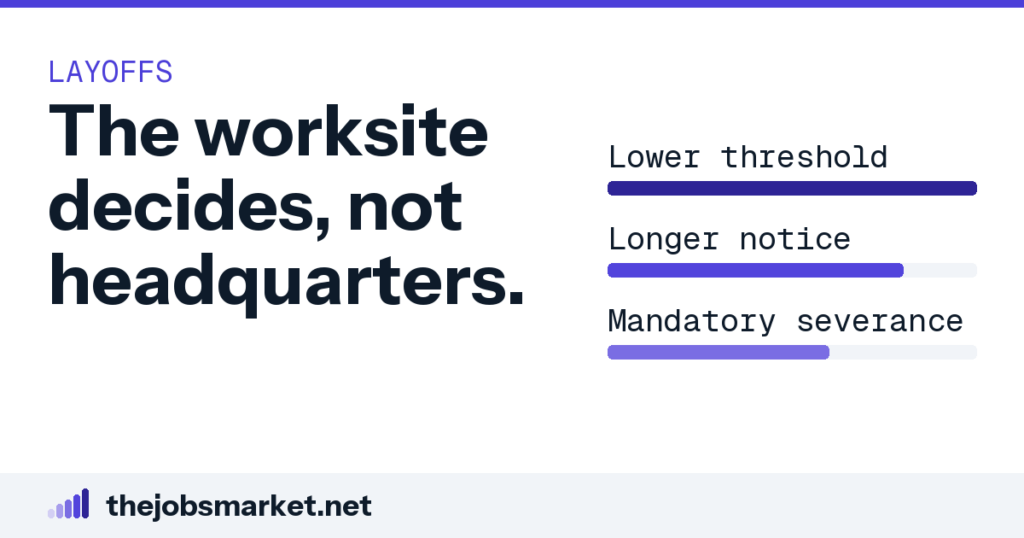
State mini-WARN laws extend the federal rule by lowering the employer size threshold, lengthening the notice period, or widening what counts as a triggering event. New York requires 90 days from employers with 50 or more employees. New Jersey requires 90 days and adds mandatory severance. California sets its own thresholds and covers some situations federal law does not.
Three ways a state law goes beyond federal
Federal WARN misses most layoffs by design, because the thresholds are high and the conditions are narrow. Several states wrote their own versions, and they extend the federal rule in three quite different directions. Knowing which direction applies to you decides whether anything is owed at all.
The first is a lower threshold. Federal WARN starts at employers with one hundred employees, and several states cover employers with fifty. That single change brings in a large band of mid-sized employers that federal law never touches at all.
The second is longer notice. New York and New Jersey require ninety days rather than sixty, which is a substantial difference when the notice period is paid. The third is mandated severance: New Jersey requires it based on years of service in covered mass layoffs, the only state that does, and a genuine departure from the American norm that severance is a contract rather than an entitlement.
Why the state rule is the one to check first
A layoff generating no federal obligation whatsoever can generate a substantial state one. If your employer has sixty people, federal WARN has nothing to say about your situation and your state may have a great deal. That is not an edge case; it describes a large share of American employers.
People check federal law first because it is better known, more written about and easier to find. For this particular question that order is backwards and it costs people real entitlements. The federal statute is the narrower of the two almost everywhere it matters.
It is also why plenty of people conclude they have no rights when they do. A quick search returns the federal thresholds, the employer is clearly below them, and the question gets closed. Checking the state first takes the same five minutes and answers correctly more often.
Where the definitions differ, quietly
States vary on several definitions that never make the headlines. What counts as a single employment site, whether part-time workers count toward the thresholds, how a relocation is treated, and which separations aggregate together across a period. Each of those choices can flip coverage on or off entirely.
Those definitional differences decide coverage far more often than the headline numbers do. An employer spread across three small offices in one metropolitan area might be a single site under a state law and three separate sites under federal law. That one question can determine whether any obligation exists.
None of it is visible from an employee’s position without looking it up. The definitions live in the statute and in the state agency’s own guidance rather than in any general summary. That is where to go if the headline threshold looks close.
Notice content is frequently stricter
Several states require specific information to appear in the notice itself. Common requirements include the reason for the action, the expected date, whether any bumping rights exist, and contact details for state assistance programs. Federal notice carries none of those content requirements.
A notice that satisfies federal law can therefore fall short of a state requirement on content alone. The dates and the headcounts can all be correct while the document is still deficient. That is worth knowing if you are trying to work out whether what you received was adequate.
Keep the notice exactly as it arrived, including any attachments and the envelope or email it came in. Content requirements are assessed against the document rather than against anybody’s recollection of it. A forwarded excerpt is worth considerably less than the original.
Remedies can be easier to pursue
Federal WARN is enforced in federal court and no agency investigates a claim on your behalf. That means a lawyer, a filing and a cost, which is why individual claims are rarely brought alone. The cost of getting started is the real barrier there.
Some states provide administrative enforcement instead, or civil penalties payable to the state, or both alongside a private right of action. That can mean a route that does not require you to fund litigation yourself. The agency does the work and you provide the documentation.
That difference matters more than the size of the remedy for most people. The barrier in these cases is rarely the amount at stake and is usually the cost of getting to it. A state route that starts with a form rather than a retainer changes the calculation entirely.
What to do if you think a state rule applies
Start with your state labor department’s own pages rather than a general summary. They name the threshold, the notice period, the content requirements and the enforcement route. They are the authoritative source and they are generally clearer than anything written about them.
Then gather your documentation while you still have access to it. The notice itself, any internal announcement, and a record of dates and headcounts including earlier rounds within the aggregation window. Screenshot anything that lives only in an internal system.
Do that in the first few days rather than the first few weeks. Email accounts get closed, colleagues scatter, and internal announcements become impossible to retrieve. Documentation collected afterwards is thinner and considerably harder to assemble.
The multi-state complication
An employer operating across several states may face genuinely different obligations for different groups of employees in the same layoff. That produces outcomes that look unfair from inside and are frequently correct. Two statutes applied properly can produce two different answers.
Colleagues in another state receiving ninety days when you received sixty is not necessarily a mistake. It may be two different laws applying correctly to two different worksites. The comparison that matters is your own state’s rule rather than what somebody else received.
Which is worth establishing before concluding you were treated worse than a colleague. It may be true and the reason may have nothing to do with anybody’s judgment about you. Ask which state’s rules were applied to your group.
Remote workers sit in an unsettled area
Notice laws were written around physical employment sites, at a time when nearly everybody had one. Somebody working from home in a different state from their employer’s office raises a question the statutes do not answer cleanly, and practice varies between employers. Few states have legislated specifically for the situation yet.
The prevailing approach generally looks at where you actually perform the work rather than where the office sits. That means your own state’s rules are the ones to check first, and it is the same principle that governs which state withholds your tax. Consistency between the two is a reasonable thing to expect.
Raise it specifically if you are remote, because it is easy for an employer to apply the headquarters state by default without anybody deciding to. Ask which state’s rules they applied to you, in writing. This is general information rather than legal advice, and mini-WARN coverage turns on your state and the specific facts of your employer’s operations.
Common questions
What is a mini-WARN law?
A state law extending federal WARN by lowering the employer size threshold, lengthening notice, or widening what counts as a triggering event.
Which state requires the most?
New York and New Jersey both require 90 days, and New Jersey additionally requires severance based on years of service.
Which state's law applies to me?
The one where the work is performed, not where the company is headquartered. For remote workers this is less settled and worth asking about.
Do federal and state rules both apply?
Yes, and you get the more protective. Meeting the federal 60 days in a 90-day state is not compliance.
What is most often missed?
Content requirements. States frequently demand more in the notice itself than the federal act does.
How do state mini-WARN laws differ from federal?
Lower employer thresholds (often 50 rather than 100), longer notice (90 days in New York and New Jersey), and in New Jersey mandated severance by years of service.
Which should I check first?
Your state. A layoff generating no federal obligation can generate a substantial state one, and people check federal first because it is better known.
Why might colleagues get different notice?
An employer across several states may face different obligations for different groups in the same layoff. That is two laws applying correctly, not necessarily unfairness.