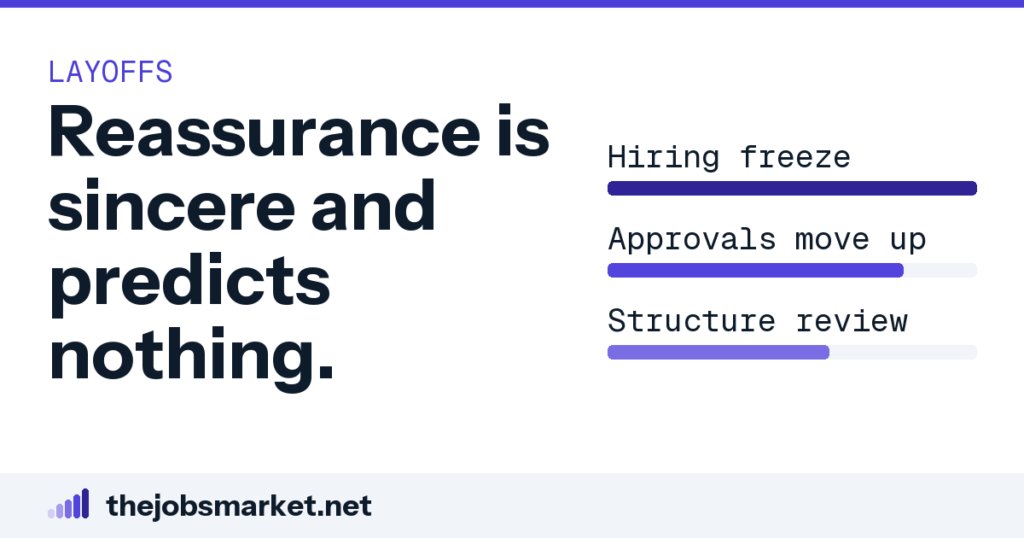
The reliable early signals are financial and procedural rather than atmospheric: a hiring freeze, unfilled vacancies after departures, budget approvals moving up a level, consultants appearing in operational areas, and unusual scrutiny of headcount reporting. Rumor and mood are poor indicators. What matters is whether the organization has started behaving as though money is scarce.
The signals that are actually reliable
The decision is usually made months before the announcement, and it leaves the same traces every time. The reliable signals are financial and procedural rather than atmospheric, which is the opposite of what most people watch for. Mood and rumor are the least predictive things in the building.
Roles going unfilled when people leave is the first and clearest. The cheapest way to reduce headcount is simply to stop replacing people, and it happens months before anything is announced. If three people left your team this year and none were replaced, that was a decision somebody made deliberately.
Discretionary spend disappearing is the second: travel, conferences, training, contractors. Contractors go first because they are easiest to stop, and their departure is the clearest early signal available from inside. Projects being paused rather than canceled is the third, because paused work requires no explanation and appears in no report.
The signals people over-read
A bad quarter is the most over-read of all, and most companies survive them routinely without touching headcount. One disappointing set of numbers is a normal event in almost any business. Companies plan for them and most absorb them without cuts.
A hiring freeze is a normal management tool and frequently temporary. A reorganization happens constantly and is as often about ambition as about retrenchment. Senior departures have many explanations, most of them personal and unrelated to anything.
Any one of these on its own means very little. The reliable read is several appearing together across a quarter, which is a genuinely different thing from noticing one and becoming anxious about it. Watch for the cluster rather than the event.
Where the public information is
For a public company, earnings calls are transcribed, published and searchable. Language about cost discipline, efficiency, right-sizing or reviewing the operating model is doing real work in those documents. Each of those phrases is chosen carefully before it is spoken.
That language appears before any internal announcement, because executives have to describe a plan to investors before they execute it. Reading two consecutive calls tells you more than a month of corridor conversation. It costs half an hour and nobody in the building will know you did it.
For any employer, public or not, job postings are the other window. A company that stops posting for your function, or posts only in one location while your site goes quiet, is telling you where it intends to grow. That signal is free and updates weekly.
What to do that costs nothing
Update your record of what you have actually done, with numbers, while you still have access to the systems holding the evidence. That is the single highest-value hour available and almost nobody spends it in advance. Doing it while the systems are open is what makes it possible.
Download your pay records and benefits statements to a personal address. Note your option exercise terms and any vesting dates coming up. All of that becomes difficult or impossible on the day access is cut.
Then have three conversations with people outside the company. Not asking for anything and not signaling anything, simply keeping a relationship warm. That is far easier to do before you need it than afterwards, and it is the part people postpone.
What not to do
Do not resign pre-emptively, whatever the atmosphere suggests. Resigning generally forfeits severance, any notice entitlement, and unemployment eligibility all at once. That is a considerable amount to give up in exchange for feeling in control of the timing.
People do it because waiting feels passive and leaving feels decisive. The arithmetic runs strongly the other way, and the difference can be months of income. Nothing about waiting requires you to stop looking elsewhere.
Do not visibly disengage either, which is the quieter version of the same instinct. Selection processes are documented, performance forms part of that documentation, and the months before a layoff are exactly when the record gets examined. Reduced effort now shapes a decision made later.
The question worth asking your manager
Do not ask whether there are going to be layoffs, because they may not be permitted to answer and the question puts them in an awkward position. It also produces a reassurance that means nothing. Sincere denials are given routinely and predict very little.
Ask instead what the team’s headcount plan looks like for next year, and whether your role is in it. That is a normal planning question, it is answerable without breaching anything, and managers field it regularly. It also signals that you are planning rather than worrying.
The quality of the answer tells you a great deal. Hesitation, vagueness or a change of subject from somebody who is usually direct is itself information. A confident specific answer is worth something too, even though it is not a guarantee.
Holding it proportionately
Most warning signs are followed by nothing at all. That is worth stating plainly, because articles like this one can make an ordinary quarter feel like a countdown. Most of the signals above resolve into nothing whatsoever.
Layoffs are currently running below their pre-pandemic norm, at about 1.77 million a month against a 2019 average near 1.82 million. The base rate of any individual being affected in a given month is low and has been getting lower rather than higher. Layoffs are genuinely less common now than before the pandemic.
The reasonable posture is preparation rather than anxiety. Everything worth doing here is cheap, useful regardless of what happens, and mostly amounts to keeping your own records in order. None of it requires you to believe anything is coming.
What the signals cannot tell you
They cannot tell you whether you specifically are on the list. Selection frequently turns on structure rather than on individual performance, and that is the part people find hardest to accept afterwards. The decision was frequently about a chart rather than a person.
A whole function goes, or a site closes, or a layer of management is removed. The strongest performer in a closed team is still in a closed team, and no amount of individual excellence changes a line on an organizational chart. That is worth knowing in advance rather than discovering it.
Worth internalizing before it happens rather than after. People laid off from well-run organizations spend a long time looking for the reason in themselves when the reason was structural and was decided by somebody who had never met them. The search for a personal explanation rarely finds a true one.
The version of preparation that is actually useful
Everything on the list above is worth doing whether or not a layoff ever comes. An accurate record of your work helps in a promotion conversation. Warm relationships outside your employer help in a job move. A clear picture of your equity and benefits helps in any negotiation.
That is the test to apply to any advice on this subject. If something is only worth doing because you are frightened, it is probably not worth doing at all. Fear is a poor guide to which preparations actually help.
If it is useful in every scenario, including the one where nothing happens, do it now and then stop watching for signs. Continuous vigilance is exhausting, produces nothing, and is the least useful response available to a situation you cannot control. Do the cheap useful things once and then get on with the work.
Common questions
What are the most reliable early signs?
A hiring freeze, roles left unfilled, spending approvals moving up a level, consultants doing structure reviews, and unusual headcount reporting.
Which signs are unreliable?
Executive departures, a single bad quarter, office moves, and leadership reassurance — which is usually sincere and not a commitment.
What should I do if I see them?
Not resign. Document your work and figures while you have system access, take copies of pay records, and reactivate your network quietly.
Why act on a weak signal?
Because preparing and being wrong costs an afternoon, while not preparing and being right costs weeks at the worst moment.
What should I check about severance?
Whether a written policy exists. That is far easier to establish before an announcement than after one.
What are the most reliable early signs?
Roles going unfilled when people leave, discretionary spend disappearing, contractors being cut, projects paused rather than canceled, and external advisers reviewing structure.
Should I resign if I think a layoff is coming?
No. Resigning generally forfeits severance, notice and unemployment eligibility — a lot to give up for control over the timing.
What should I ask my manager?
Not whether there will be layoffs, which they may not be able to answer, but what the headcount plan looks like next year and whether your role is in it.