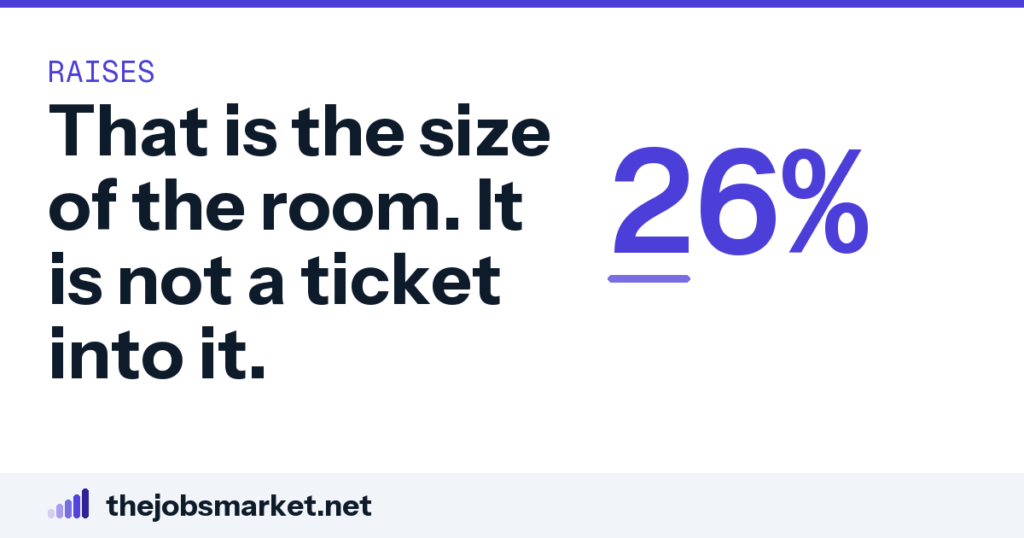
Internal increases are calculated from your existing pay and bounded by a budget. Outside offers are calculated from the market. Across the 391 published occupations with at least 50,000 workers, the step from the median wage to the 75th percentile is a median of 26 percent — a distance ordinary annual increases do not cover. That is a fact about the published distribution, not a promise about any individual move.
Why the claim has real force
Everybody has heard that the only way to get a real raise is to leave. It is repeated so often that it functions as folklore, and underneath the folklore is a genuine piece of arithmetic. Internal increases are calculated as percentages of what you already earn. External offers are calculated against what the market charges for the role today.
When your salary sits below the current market, which it usually does after a few years in one place, the external route produces a larger number for the same work. Employer bands make it worse in a small way: they are refreshed annually against survey data describing a period a year back. So the internal structure is always slightly behind the market it is trying to track, and the gap compounds quietly.
The published distribution gives the size of the room. Across the 391 occupations with at least 50,000 workers, the median step from the fiftieth percentile to the seventy-fifth is about 26 percent. That is the distance ordinary annual increases do not cover, and it is a fact about the data rather than a promise about any individual move.
The arithmetic in one example
Somebody hired five years ago at $70,000, receiving a reliable three percent a year, now earns about $81,100. The same role advertised today might start at $88,000 because that is what hiring costs now. The gap is roughly $6,900 and nobody did anything wrong to produce it.
Next year both people receive three percent. The established employee gains $2,434 and the new hire gains $2,640, so the gap widens by another $200 while the percentages are identical. That is the mechanism in a single calculation. No annual increase closes a gap that grows every time an annual increase is applied.
Closing it requires a step rather than a rate: a market adjustment, a promotion into a different band, or a move. Those are the only three instruments capable of the job. Waiting is not a fourth option, it is the thing producing the problem.
Why the claim is still overstated
Market adjustments exist as a formal category at most organizations and they are granted more often than people expect. Replacing you costs recruiting fees, a market-rate salary for your replacement, and months of reduced output while somebody learns the role. Adjusting your pay is frequently the cheaper option and managers generally know it.
The trouble is that most people never ask. The comparison that gets made in somebody’s head is between leaving and doing nothing, when the actual choice includes a conversation almost nobody has. That conversation is free, it sometimes works, and it costs no goodwill when it is framed as a question about pricing rather than fairness.
What leaving costs that the salary hides
Unvested equity and unvested employer retirement contributions are the first item, and they vest no slower than a three-year cliff or six-year graded schedule. Any bonus requiring you to be employed on a future payment date is the second. A gap in health coverage is the third, where the new plan starts after thirty or sixty days.
Then there is the first year itself, which carries no internal credit, no relationships and no knowledge of where decisions actually get made. That is a real cost even when the number on the offer is clearly better. It does not usually change the answer and it belongs in the calculation. People who move purely on base pay are often surprised by the first six months.
The pattern that beats both extremes
The approach that works is alternating rather than committing to one strategy. Take an internal promotion when it crosses a genuine level with a different band attached. Then reprice externally when internal progression flattens against the top of that band.
People who only ever move externally accumulate no institutional standing anywhere, which caps how senior they can get. People who never move accumulate a compounding gap they cannot close from inside. The mixed approach is what the two pay mechanisms actually reward, because it uses each one where it is strong. Neither extreme is a plan.
Run the internal conversation first
Bring three things: the published median for your occupation in your metro, your employer’s own advertised ranges for your level, and a record of what you delivered. Ask specifically for a market adjustment as a category separate from merit. That framing matters because it is a different budget and a different approval path.
If the answer is a clear no, with the reason being that the band itself sits below market, you have found your ceiling. The external move then becomes an informed decision rather than a gamble, and you know exactly what you are choosing between. That knowledge is worth having whichever way you decide. It also takes one conversation to obtain.
The move that is neither leaving nor waiting
Changing employer or industry at the same level is the option that almost never gets considered. It frequently pays more than the next internal promotion, costs less time, and is available now rather than whenever a position happens to open. It also feels like the smallest move available, which is why it gets overlooked.
Most occupations exist across several industries, and the same function is priced differently depending on who is buying it. A capability that is support work in one sector is core work in another, and the pay follows that distinction more than it follows your performance. Moving sideways into a sector that is hiring is one of the largest single steps available. The job title need not change at all.
Timing the departure around what you would forfeit
List every unvested grant with its date, every employer retirement contribution not yet vested, and any bonus that requires employment on a payment date. Put the dates in one column and the amounts in another. That list takes twenty minutes to assemble and it frequently changes the timing of a move by a quarter.
Where a cliff or a large tranche sits within a few months, waiting usually beats the increase from moving sooner. Where the next event is a year out and refresh grants keep arriving behind it, waiting becomes an indefinite commitment. At that point the vesting schedule is doing exactly the job it was designed to do. Recognize it and decide deliberately.
When leaving genuinely is the answer
Leave when the band itself sits below market and will not move, because no performance changes a structural fact. Leave when two cycles have passed with agreed criteria met and nothing changing. Leave when the only repricing mechanism this employer uses is somebody handing in their notice.
Those are facts about the organization rather than about you, and none of them improves with a better review. Leaving is frequently the largest single raise available and it is not the only one. The people who do best treat it as one instrument among several rather than as the only lever that works, which means running the internal conversation properly first — not out of loyalty, but because it is cheap and it tells you exactly what you are choosing between.
Common questions
Does changing jobs always pay more?
No. The distribution shows the room exists; it says nothing about a particular move. Plenty of moves are lateral or worse.
Where does the 26 percent come from?
The median step from the 50th to the 75th percentile across the 391 occupations with at least 50,000 workers in the May 2025 national wage data.
Why can't internal increases close that gap?
Because they are a small percentage of your existing pay, so they compound a starting point rather than resetting it against the market.
What is staying worth?
Context, relationships, vesting, accrued leave, and avoiding the real risk that a new job is worse. None of it appears in a salary comparison.
What should I do first?
Get one genuine offer, whether or not you intend to take it. Until then both sides of the argument are guesses.
Is leaving the only way to get a real raise?
It is frequently the largest single increase available, but market adjustments exist and are granted more often than people expect — most never ask.
Why do external offers pay more?
Internal increases are percentages of your current salary; external offers are priced against today's market rate for the role.
What does leaving cost?
Unvested equity and retirement contributions, any bonus requiring employment on a payment date, a possible coverage gap, and a first year with no internal standing.